Fully Automated QA That Nobody Believes
The promise of automated QA is simple: every call reviewed, instantly, without a team of people listening all day.
Then the first wrong flag arrives. An agent is marked down for rudeness — but listening to the call, they were repeating what the customer had said. Another is flagged for skipping the greeting, which they did in Hindi. A third is flagged on a call that was actually handled well.
Each mistake is small. Together, they do something much bigger: they teach the team that the flags can’t be trusted.
Why fully automated QA loses trust
Mistakes are confident. A wrong flag looks exactly as certain as a right one. There’s no way to tell them apart without listening.
Context is hard. Sarcasm, quoting the customer, a joke between an agent and a regular caller — these are easy for people and hard for machines.
Mixed languages trip it up. On calls that switch between Hindi and English, automated tools are more likely to mishear and misjudge.
One bad flag affects all of them. Once a team leader has been embarrassed by a wrong flag in front of an agent, they stop raising the others.
What happens next
The pattern is common. A team adopts automated QA, finds a few wrong flags, stops trusting it, and goes back to manual sampling. They end up paying for a tool and still only hearing a small share of their calls.
The problem was never automation itself. It was automation without anyone checking it.
Put a person between the AI and the agent
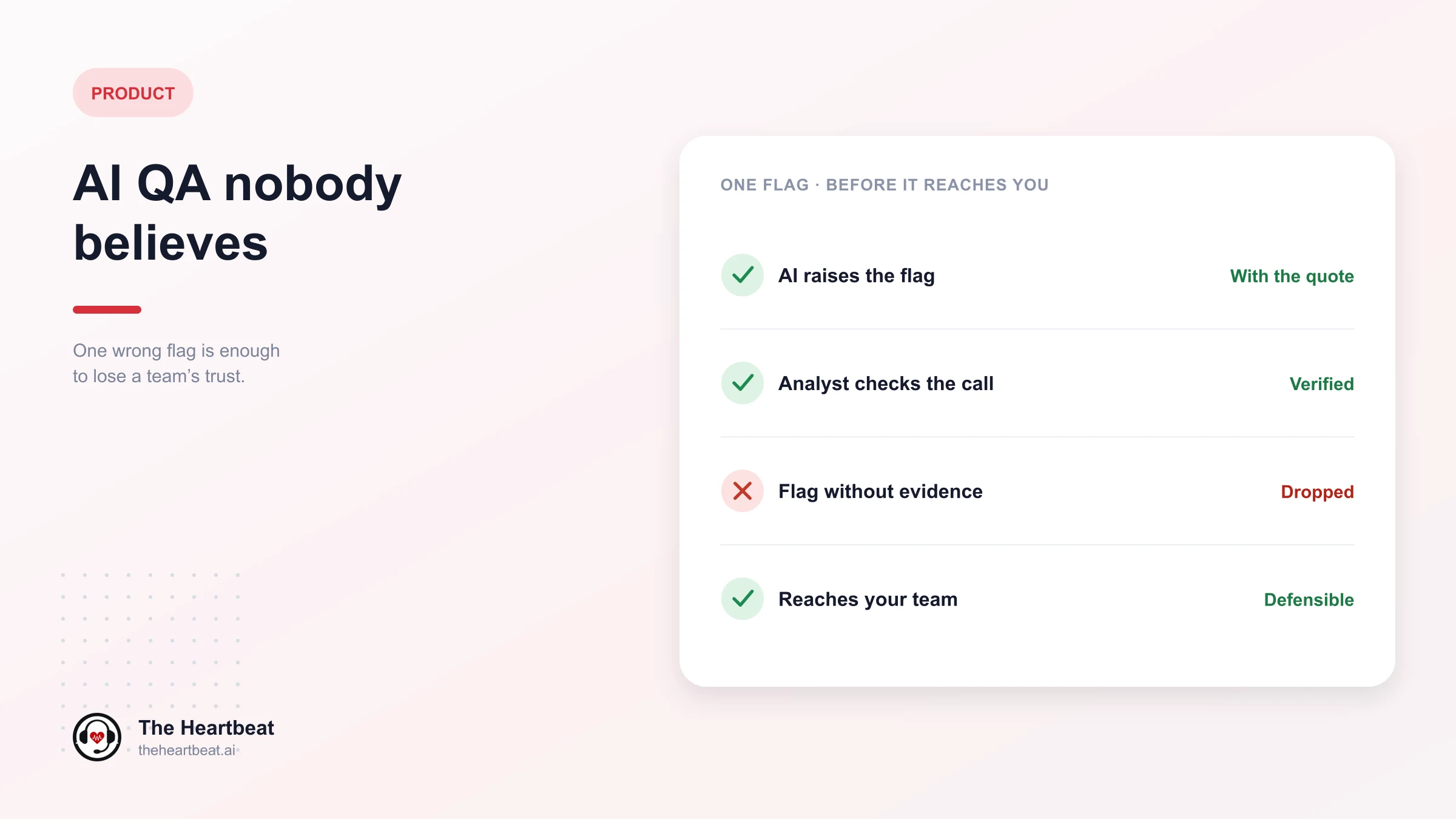
The fix is to keep the speed of AI and add a human check before any finding reaches a team leader or an agent.
- AI reviews every call and raises what looks notable.
- An analyst checks each flag against the call before it goes anywhere.
- Every finding carries its evidence — the exact sentence — so anyone can check it themselves.
- Findings without evidence are dropped, not passed on as a guess.
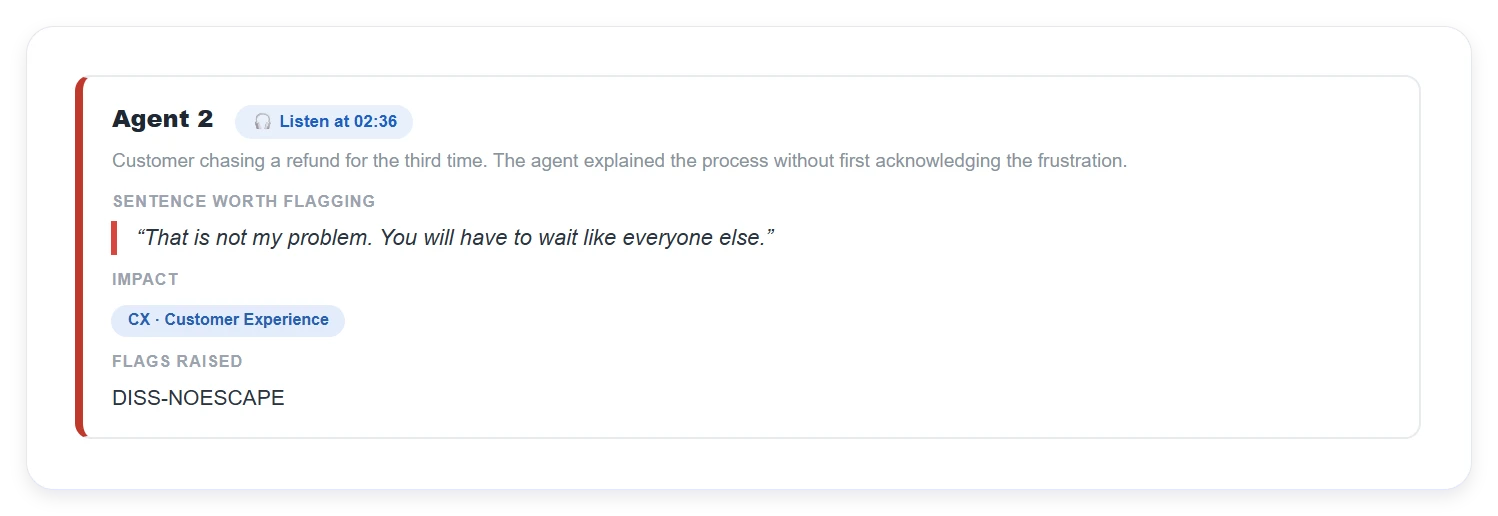
From The Heartbeat weekly report: a flag that reached the report after an analyst checked it. It carries the verbatim sentence and a link to the exact second, 02:36, so anyone can hear it for themselves in seconds. A finding without a quote doesn’t reach the report.

From The Heartbeat app: an analyst’s notes on the call itself. One flag was checked against the recording and kept. The other was dropped, because the agent was repeating the customer’s words, not being rude. Tagging the team leader brings them straight to the call.
What to look for in AI-driven QA
1. Who checks the flags? If the answer is “nobody”, expect the first wrong one to undo the rest.
2. Does every flag come with evidence? A quote from the call lets anyone verify it in seconds.
3. Can you get from the flag to the call? Team leaders need to hear the moment for themselves before coaching on it.
4. How does it handle your languages? Test it on your own mixed-language calls, not a clean demo.
5. What happens to findings it isn’t sure about? They should be checked or left out, not passed on as fact.
How The Heartbeat handles this
The Heartbeat reviews 100% of your agents’ calls, in any department, in Hindi, English or Hinglish.
It works as Analysts + AI: every AI flag is checked by a trained analyst before it reaches you. Each flag carries the exact sentence from the transcript as evidence, and a finding without a quote doesn’t reach your report. So when a team leader raises a flag with an agent, they can stand behind it. Your data stays in India, hosted on AWS ap-south-1 (Mumbai).
Automation gives you every call. A human check is what makes the results worth acting on.