Staying Compliant on Debt-Collection Calls: A Practical Guide
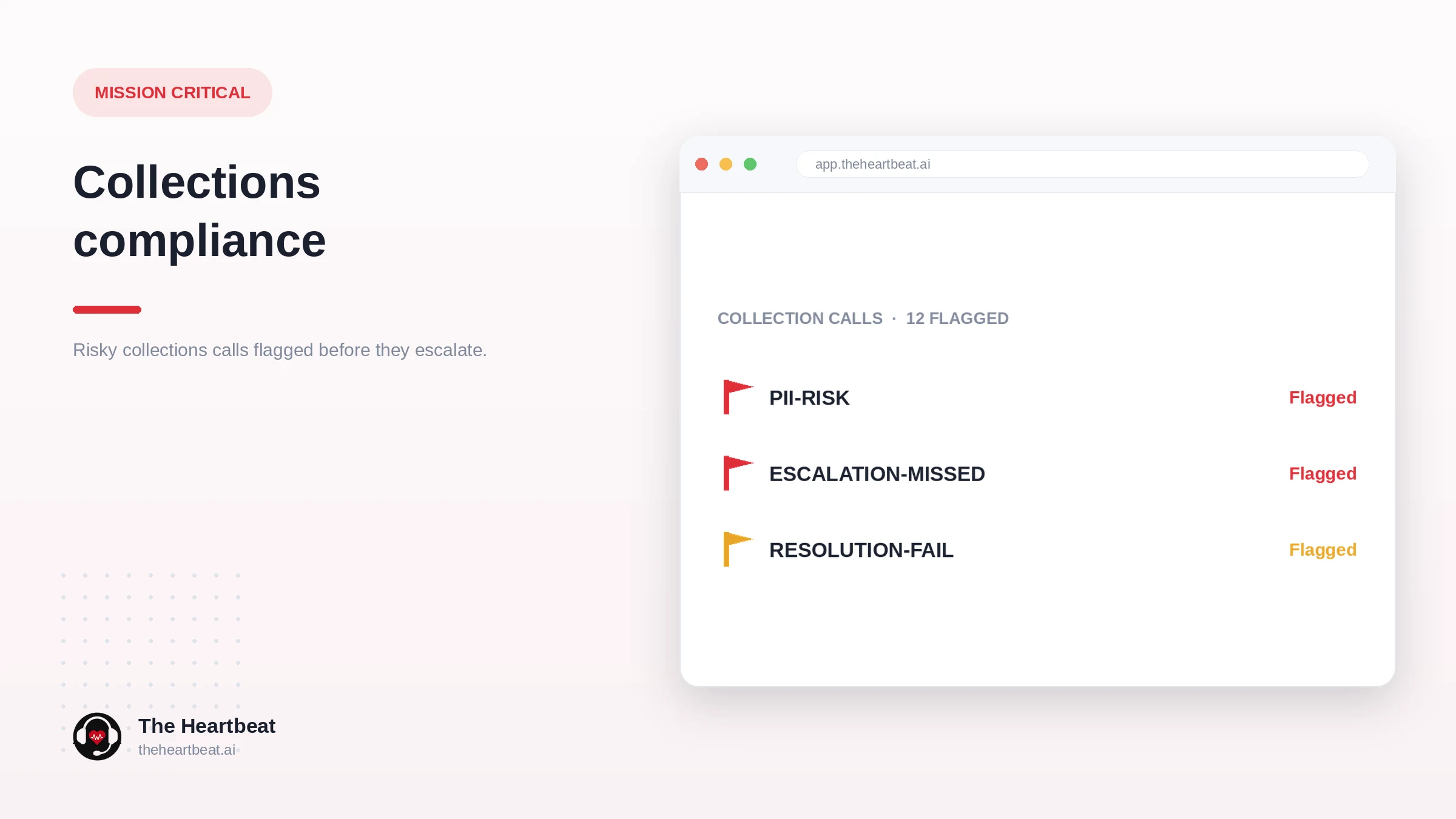
Debt collection is the part of the contact-centre world where a single call can turn into a genuine problem — a complaint, a reputational hit, or a regulatory question about how a customer was treated. The pressure to recover is real, the conversations are tense, and the line between firm and unacceptable can be crossed in a sentence.
For an NBFC, a lending BPO, or an in-house collections team, staying compliant is not about a policy document. It is about what actually happens on the call — and whether you would know if something went wrong.
The behaviours that create risk
Collections compliance concerns tend to cluster around a handful of recognisable behaviours. You do not need a legal background to spot them; you need to know they exist and to be listening for them.
Threats and intimidation. Language that threatens consequences the lender cannot or would not actually pursue — legal action, contacting an employer, public embarrassment — as leverage. This is where the most serious complaints originate.
Calling at the wrong time or too often. Repeated calls, calls outside reasonable hours, and pressure that tips into harassment. Any single call may sound fine; the pattern across the week is where the problem lives.
Contacting the wrong people. Discussing a customer’s debt with family, neighbours, or colleagues rather than the borrower. It feels like leverage to an agent under target pressure. It is exactly the behaviour that draws scrutiny.
Misrepresentation. Overstating the amount owed, inventing fees, or misdescribing the consequences of non-payment to secure a commitment.
Mishandling a vulnerable customer. A borrower in genuine distress needs a different response from a borrower who is simply avoiding the call. An agent who cannot tell the difference — or who does not adjust — creates both a compliance and a human risk.
Why sampling misses exactly the wrong calls
Here is the uncomfortable arithmetic of manual QA. A typical floor reviews 5–10% of calls, chosen more or less at random or by whoever the team leader had time for. The risky call — the one where an agent under month-end pressure lost their temper — is a rare event. Rare events almost never land in a small random sample.
So the calls that get reviewed are the ordinary ones, and the calls that create real exposure are the ones nobody hears. The QA scorecard looks healthy right up until the moment a complaint arrives about a call that was never in the sample. The problem is not that the QA team is careless. It is that the method cannot, by design, find a needle when it only searches 5% of the haystack.
What good looks like
Getting collections compliance under control comes down to changing what you can see.
- Review every call, not a sample. With analysts and AI auditing 100% of calls, the rare high-risk conversation is no longer a matter of luck. If an agent made a prohibited threat, it is in the audit whether or not anyone would have thought to sample that call.
- Catch patterns, not just single calls. Some breaches are one bad sentence. Others — call frequency, timing, repeated pressure — only appear when you look across an agent’s week. Complete coverage makes the pattern visible.
- Verify before you act. Collections language is context-heavy. A firm reminder is not a threat; a settlement offer is not misrepresentation. Every AI flag being reviewed by a trained analyst before it reaches a manager means you are coaching on real breaches, not on a model’s misreading.
- Turn it into coaching, not just catching. The point is not to punish agents after the fact. It is to surface the specific coachable moment — what was said, why it was a problem, what should have been said — so the same breach does not recur next week.
The practical starting point
You do not have to overhaul the floor to find out where you stand. Take a week of last month’s collections calls and have every one of them audited against your compliance rules. The output is a plain answer to a question most collections leaders cannot currently answer with confidence: across everything my floor said last week, where are we exposed?
On a collections floor, what you cannot hear is what hurts you. Closing that gap — moving from a sample to the whole floor, with human-verified flags — is the difference between hoping you are compliant and being able to show it.