Monitoring Call Quality in Hinglish and Multilingual Contact Centres
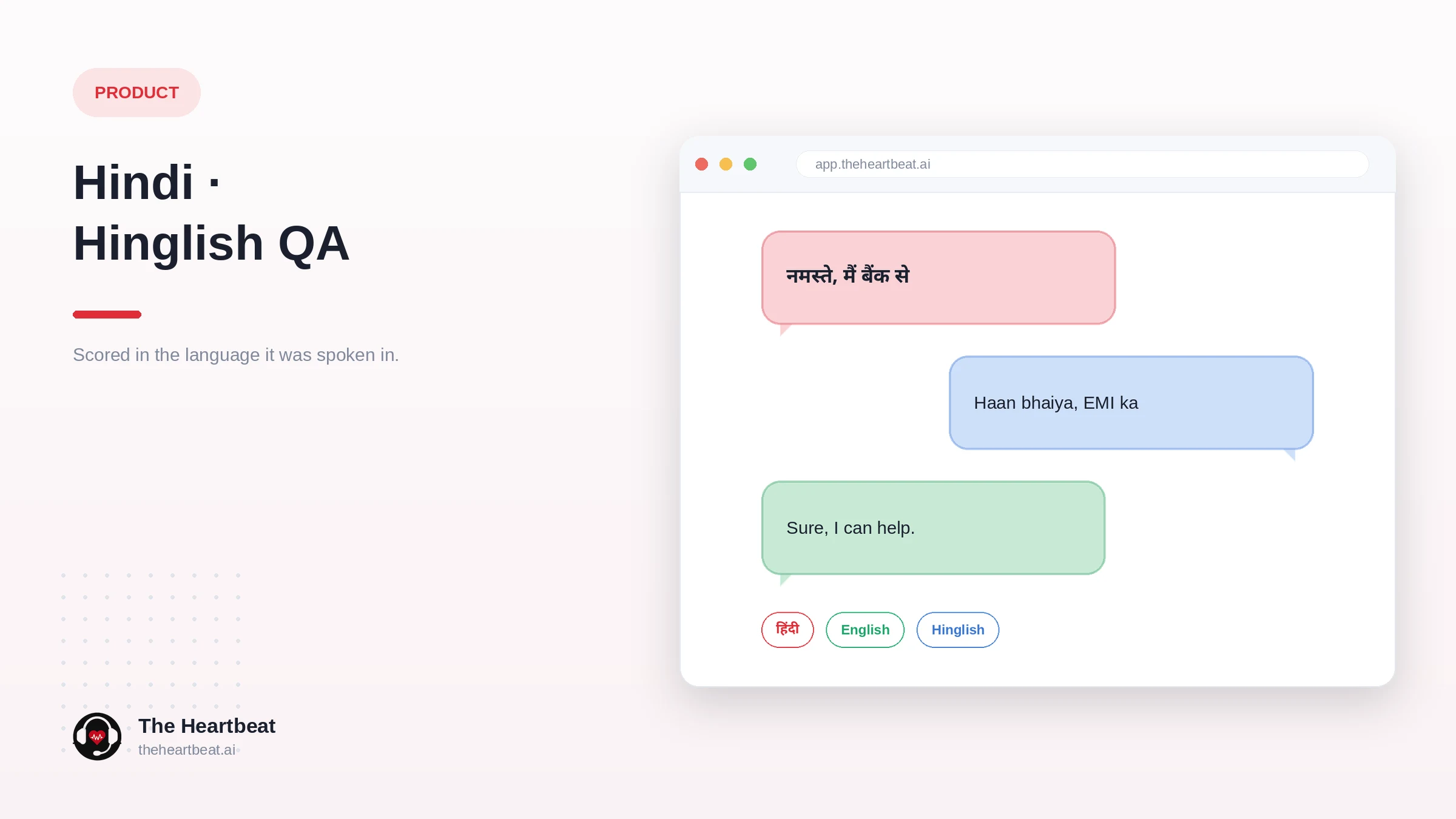
Listen to five minutes of a real Indian collections or support call and you will hear something no textbook prepares a tool for. The agent opens in English, the customer answers in Hindi, the agent switches to match, and within a single sentence both are code-switching — “Sir aapka payment overdue hai, but we can arrange a settlement if aap aaj confirm kar dein.” This is not broken language. It is how tens of millions of Indian conversations actually happen.
The problem is that most call-monitoring and transcription tools were built somewhere else, for clean single-language audio. On a Hinglish floor, they quietly fall apart — and because the failure is silent, nobody notices until the QA data stops making sense.
How language breaks monitoring tools
The damage happens in stages, and each stage compounds the next.
Transcription degrades first. A model tuned for English will mangle Hindi words, and one tuned for Hindi will stumble over the English fragments. Code-switching mid-sentence is the hardest case of all, because the model has to change its expectations word by word. A poor transcript is not a small problem — every downstream step reads from it.
Tagging then misfires. If the compliance rules look for a phrase and the transcript garbled it, the breach is invisible. Worse, a mistranscription can invent a phrase that was never said, producing a false flag. Either way, the audit is now unreliable in a way that is impossible to see from the summary numbers.
Scoring inherits every error above it. An agent who handled a difficult Hindi call perfectly can score badly because the tool could not follow the conversation. An agent who breached compliance in Hinglish can score well because the breach never made it into text. The leaderboard is now actively misleading.
The insidious part is that none of this shows up as an error message. The dashboard fills in, the charts render, the numbers look plausible. They are just wrong.
What accurate multilingual monitoring requires
Getting this right is less about one clever feature and more about designing for the reality of the floor from the start.
- Native handling of Hindi, English and Hinglish. Not English with a translation layer bolted on, but processing built to expect code-switching as the normal case rather than the exception. We are deliberate about phrasing this as “Hindi, English and Hinglish” — because “multilingual” as a vague claim usually means “English, and it copes with the rest.”
- Human verification where the machine is least certain. Code-switched, accented, and noisy passages are exactly where automated transcription and tagging are weakest — and exactly where a wrong flag does the most damage. A trained analyst reviewing the flags catches the cases the model got confused by, so a garbled transcript does not become a false accusation against an agent.
- Complete coverage, not a sample. Language problems are not evenly distributed. The hardest calls to transcribe are often the highest-risk ones. Sampling 5–10% of calls means the difficult, code-switched, high-stakes conversations are the ones most likely to be missed.
Why it matters beyond accuracy
There is a fairness dimension here that is easy to overlook. If your monitoring penalises agents for speaking the way your customers actually speak, you are coaching the wrong behaviour. An agent who fluently switches to Hindi to calm an anxious customer is doing the job well. A tool that scores them poorly because it could not follow the switch is teaching your best agents to sound worse.
Accurate multilingual monitoring is not a nice-to-have for an Indian floor. It is the precondition for the QA data meaning anything at all. Before you trust a single number from a monitoring system, the honest question is simple: does it understand the language your floor is actually spoken in — or only the language it was built for?