
Why Stereo Call Recording Matters for Accurate Analysis
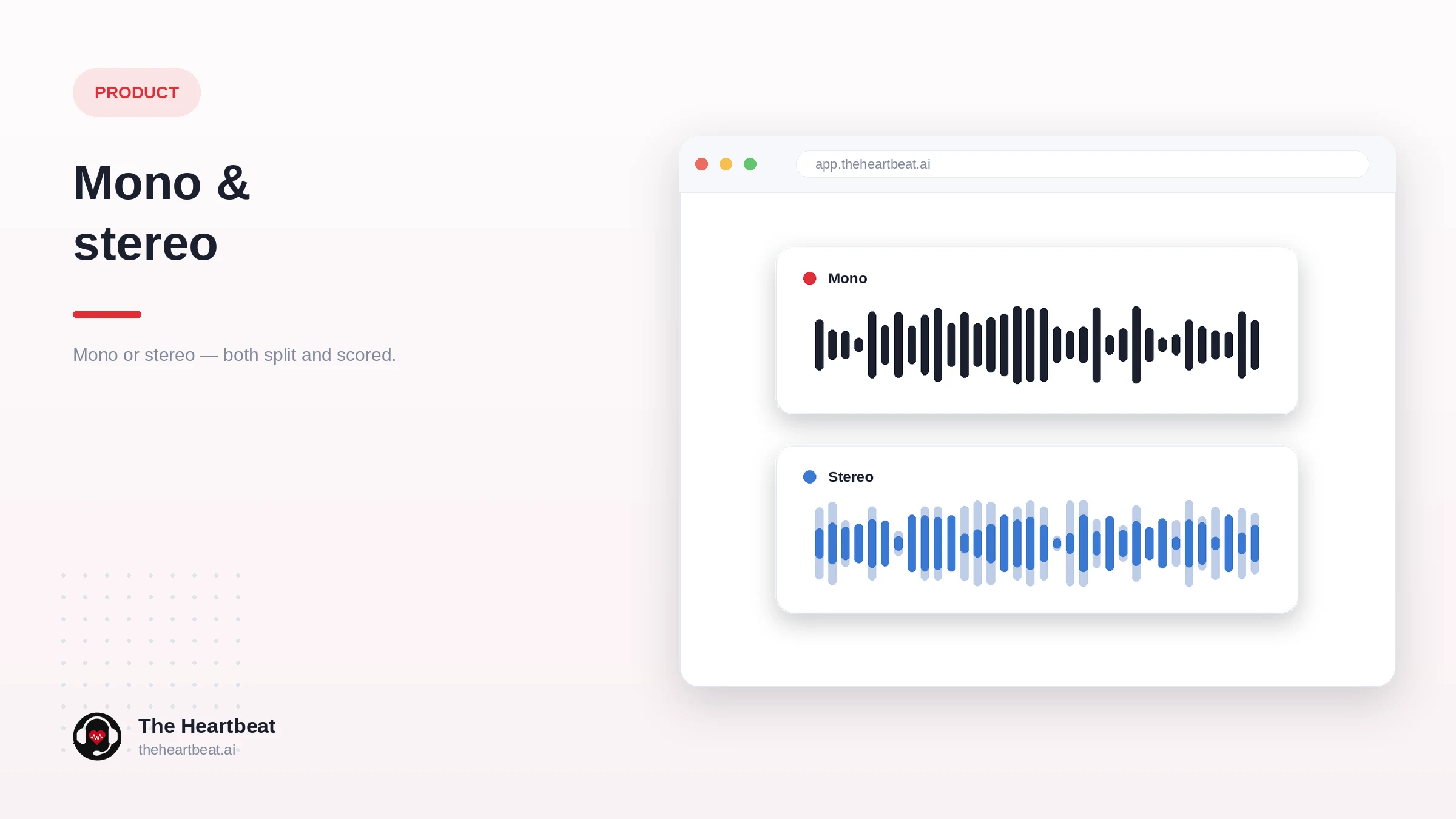
Most conversations about call QA never get to the audio format, which is a shame, because it shapes everything that follows. Whether your dialer produces mono or stereo recordings changes what an analysis can see — and understanding the difference helps you read your own QA data more honestly.
The difference in one paragraph
A stereo recording keeps two separate channels: the agent on one, the customer on the other. A mono recording mixes both voices into a single channel. It is the difference between a recording where you always know who is speaking and one where you have to work it out from context.
That distinction sounds academic until you try to analyse thousands of calls.
Why stereo makes analysis cleaner
When the agent and customer sit on separate channels, several hard problems simply disappear.
Speaker attribution is exact. You never have to guess who said the thing that matters. If a prohibited threat or a missing disclosure appears, it is unambiguously attributed to the agent, because the agent’s words are physically on their own channel.
Interruptions and talk-over are legible. On a tense collections call, the agent talking over the customer is itself a behaviour worth coaching. In stereo, overlapping speech is two clean channels; in mono, it is one muddy blur where both voices collide and neither transcribes well.
Transcription quality improves. Separating the speakers before transcription means the model works on one voice at a time, rather than trying to untangle two people at once — which matters even more when the call is code-switching between Hindi, English, and Hinglish.
In short, stereo gives an analysis a cleaner starting point, and cleaner input means more reliable flags and scores downstream.
But most Indian floors run on mono
Here is the practical reality: the majority of dialers deployed on Indian floors produce mono recordings by default. Stereo is available on many systems but often is not switched on, and re-configuring a live dialer across hundreds of agents is not a small undertaking.
This is exactly the wrong place to put a barrier. If good QA required every floor to re-plumb its recording infrastructure first, most would never start. And the floors most in need of better QA are frequently the ones least able to pause operations to reconfigure their telephony.
The right stance: analyse what your dialer already produces
The sensible position is that the recording format should be our problem, not yours. A QA process should audit both mono and stereo, taking whatever your existing setup produces, with no change to how you record.
That means:
- If you already have stereo, the analysis takes full advantage of channel separation for cleaner attribution and transcription.
- If you produce mono, the analysis handles speaker separation on its side, so you still get an attributed, tagged, scored audit — without touching your dialer.
The point of raising mono versus stereo is not to send you off on an infrastructure project. It is to be honest that the two formats give an analysis different starting material, and to be clear that adapting to your format is the vendor’s job. You send the files your dialer already produces; you get the weekly report back.
What to ask
If you are evaluating any call-analysis approach, the useful question is not “do you need stereo.” It is “what do you do with the mono recordings I actually have, and does the quality of the audit hold up on them?” A process that quietly requires stereo, or that degrades badly on mono without telling you, is one that will underperform on the majority of Indian floors — including, quite possibly, yours.
Stereo is the cleaner input. Meeting you where your dialer already is, is the more useful commitment.