Automating Call QA: Auditing 100% of Calls, Not 2%
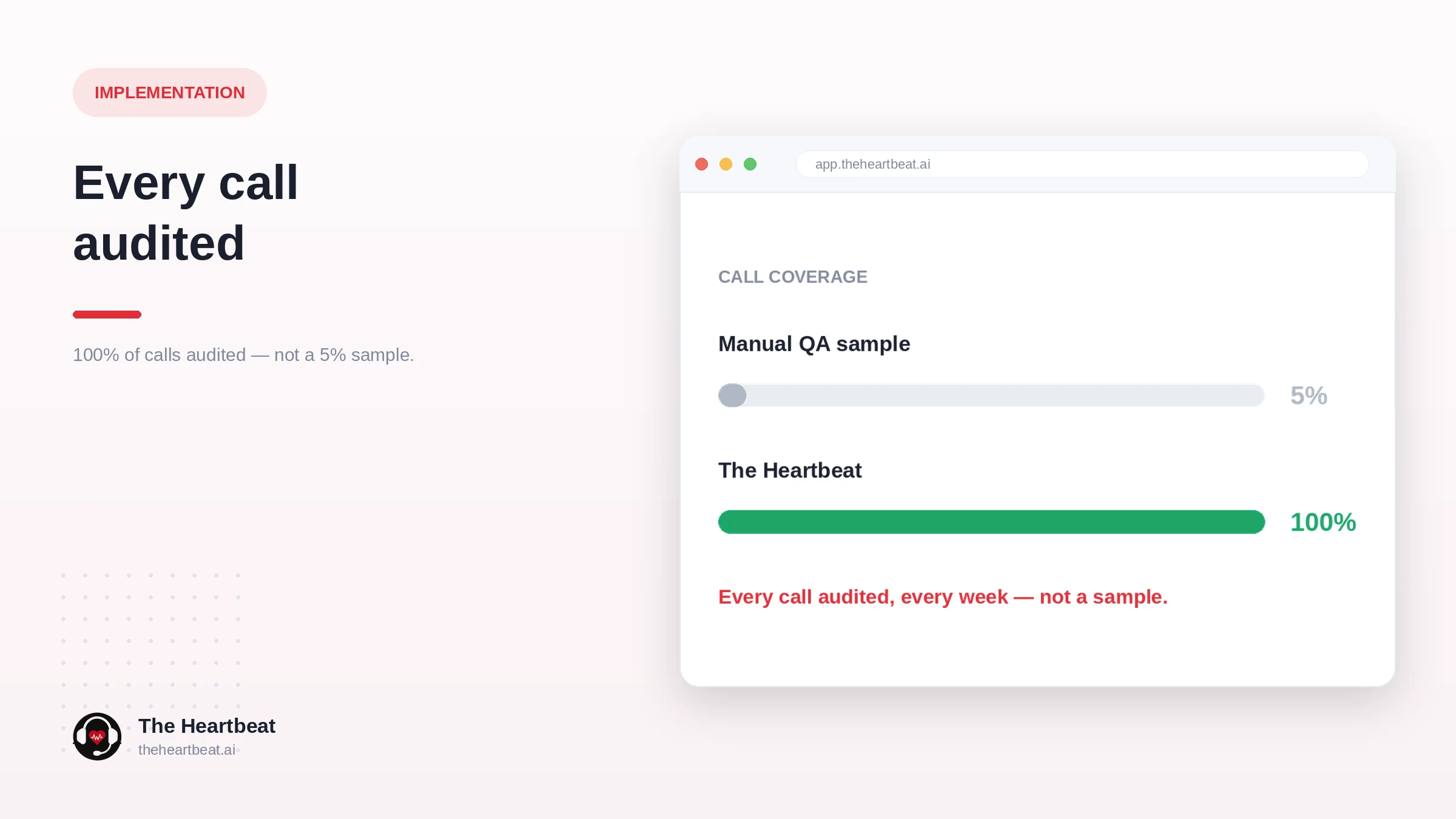
Here is a calculation worth doing on your own floor. Take the number of calls your agents make in a week. Now take the number of calls your QA team can genuinely review in that week — really listen to, score, and note. Divide the second by the first. On most busy Indian floors the answer lands somewhere between 2% and 10%.
Everything you believe about your call quality is extrapolated from that sliver. The other 90-plus percent is a blind spot you have simply learned to live with.
Why manual QA cannot win this fight
The instinct is to solve the coverage problem by hiring more reviewers. It does not work, for a reason that is structural rather than about effort.
Reviewing a call properly takes time — often longer than the call itself, once you account for scoring and note-taking. That means QA capacity scales linearly with headcount, while call volume scales with the business. A floor that doubles its agents does not double its QA team; QA is a cost centre, so it stays roughly the same size and simply reviews a smaller slice. The percentage covered goes down as the business grows. Manual QA does not just fail to reach 100% — it drifts further from it over time.
And the calls it does reach are not chosen for risk. They are chosen for convenience: whoever the reviewer had time for, whatever surfaced through a complaint. The riskiest calls are rare, and rare things do not show up in small convenience samples.
What automation actually changes
Automating the processing step breaks the link between coverage and headcount. When AI transcribes, tags, and risk-scores every call overnight, coverage stops being a function of how many reviewers you employ. You go from auditing a sample to auditing the floor.
That single change has effects that ripple outward:
- Rare high-risk calls stop hiding. The one prohibited threat, the one mishandled vulnerable customer — if it happened, it is in the audit, because the audit no longer skips 90% of calls.
- Scores become facts about agents, not about samples. A compliance score built on every call an agent made is defensible in a way a sample-based score never is.
- Patterns become visible. Behaviours that only appear across many calls — timing, frequency, repeated small deviations — are invisible in a sample and obvious across the whole set.
The trap in “fully automated”
Here is where a lot of automation pitches quietly overreach. It is tempting to conclude that if AI can process every call, you can remove the humans entirely and let the flags flow straight to managers.
That is the trap. Language is ambiguous, especially across Hindi, English, and Hinglish, and especially on tense collections calls where tone changes meaning. An AI flag is a strong lead, not a proven breach. Send raw, unverified flags to a manager’s desk and two things happen: false positives waste their time, and the first obviously-wrong flag destroys trust in every flag after it. A QA system nobody trusts is worse than the manual one it replaced, because it also looks authoritative.
The version that works keeps a trained analyst in the loop — reviewing every AI flag before it reaches you, so what lands on your desk is verified. We describe it as analysts + AI on purpose: the AI delivers the coverage, the analysts deliver the trust. Automate the processing, not the judgement.
What to expect on the ground
Moving from 2% to 100% coverage does not mean drowning in a hundred times more findings. Most calls are fine, and a well-designed audit says so quickly. What changes is that the small number of calls that genuinely matter — the breaches, the coaching moments, the customers who need a callback — surface on their own, instead of waiting to be discovered by a complaint.
The goal of automating call QA is not to review more calls for its own sake. It is to make sure the call that could hurt you is one you have already seen — and that a human has confirmed is real — before anyone outside the building does.