You're Reviewing 2% of Calls. The Serious One Is in the Other 98%.
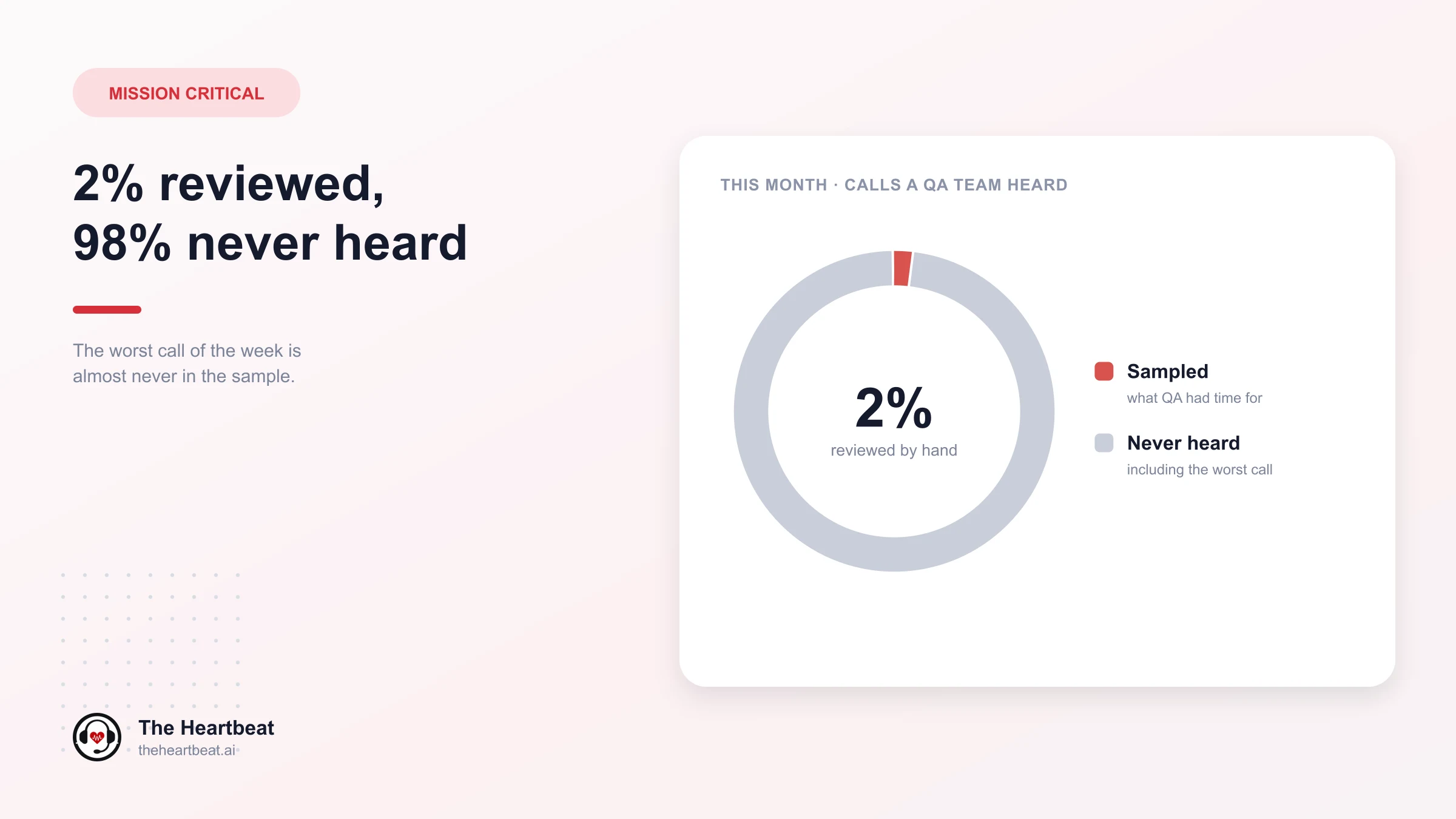
Ask any QA manager how many calls their team reviews, and the honest answer is usually a small number. A few calls per agent per month. Maybe two in every hundred across the floor.
That isn’t a failing of the QA team. It’s simple maths. A call takes as long to review as it took to handle, often longer. However hard the team works, there are far more calls than there are hours to hear them.
So every contact centre ends up making the same quiet assumption: that the calls they review are a fair picture of the calls they don’t. Most of the time, that assumption is wrong.
Why the sample misses the call that matters
Serious calls are rare. An agent losing their temper, sharing account details with the wrong person, or leaving an upset customer with nothing — these might happen on one call in several hundred.
A 2% sample is very good at telling you what a normal call sounds like. It is very bad at finding a rare one. If one call in 300 is serious, a team reviewing two calls in every hundred will usually miss it entirely. Not because anyone was careless, but because it was never in the pile.
And the calls that do get picked are rarely random. Reviewers pick calls of a reasonable length, from agents they’ve been asked to look at, on days they have time. The calls nobody chooses — the very long ones, the very short ones, the late shift — are exactly where problems hide.
What gets missed when only a sample is heard
The rare serious call. The one that becomes a complaint, a social media post or a regulator’s question. It’s usually found when the customer brings it back, weeks later.
Patterns across the floor. One skipped step on one reviewed call looks like a slip. The same step skipped on 600 unreviewed calls is how the team actually works.
Agents who are never sampled. Some agents simply don’t come up often. Their habits — good and bad — go unseen for months.
Fair comparisons. If one agent was judged on three calls and another on eight, their scores aren’t measuring the same thing.
“Can’t we just sample more?”
Teams usually try. They add reviewers, shorten scorecards, or speed up playback. Each helps a little, and none changes the basic problem: review time grows with call volume, and call volume always wins.
Doubling the sample from 2% to 4% still leaves 96% of calls unheard. The serious call is still far more likely to be in the part nobody reached.
What changes when every call is covered
When every call is processed, the question stops being “which calls should we listen to?” and becomes “which of these calls need a person’s attention?”

From The Heartbeat app: a month on one floor. All 4,812 calls were processed, not a sample, and 674 of them came out negative. A 2% sample would have heard fewer than 100 calls in total.
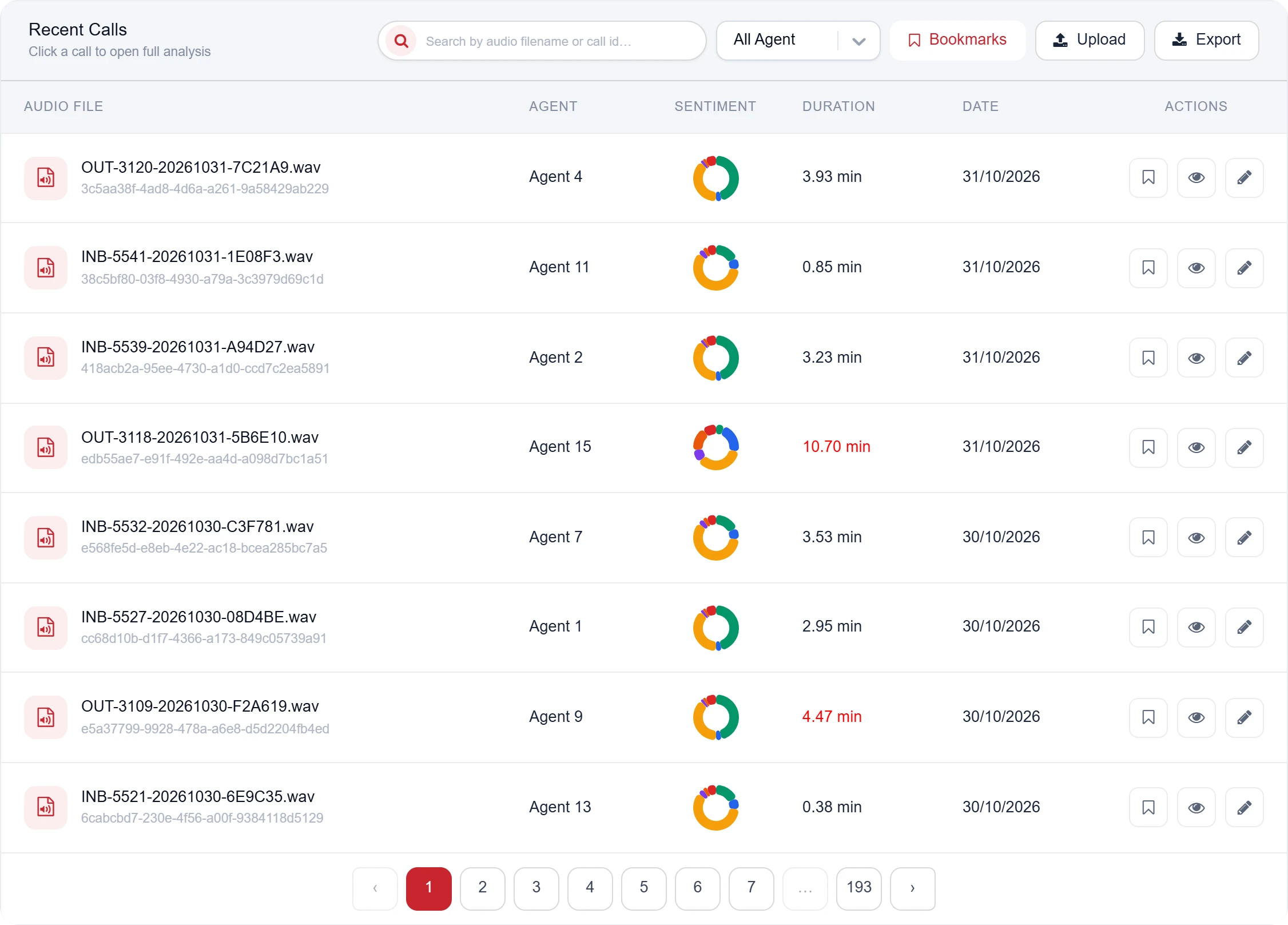
From The Heartbeat app: every call in the month is in the list, 193 pages of it. That includes the calls a reviewer would rarely pick: a 23-second call, and a 10.7-minute call shown in red for running far over the duration goal.
That shifts what the QA team spends its time on:
- Nothing is chosen in advance. The long call, the short call and the late-shift call are all scored the same way.
- Rare calls surface. A serious call stands out from the rest instead of hiding in the unheard 98%.
- Patterns become visible. When every call is scored, a gap that shows up on most of an agent’s calls is obvious.
- Every agent is judged on all their calls. Not on whichever three happened to be picked.
What to do with full coverage
1. Stop picking calls; start picking agents and moments. Let the scores tell you where to look, then listen to those calls properly.
2. Keep people on the judgement calls. Full coverage doesn’t replace your QA team. It gives them a much better place to start.
3. Act on the rare call quickly. The value of finding a serious call drops every day it sits unread.
How The Heartbeat handles this
The Heartbeat reviews 100% of your agents’ calls, in any department. Analysts + AI go through every recording, in Hindi, English or Hinglish, and every AI flag is checked by a trained analyst before it reaches you.
Every call you connect is processed and scored, not a sample. Recordings can be uploaded or pulled automatically from your cloud storage on a schedule, and each one is scored the same way, so the calls that need attention stand out on their own. Your data stays in India, hosted on AWS ap-south-1 (Mumbai).
A sample tells you what an average call sounds like. The call that hurts you is never average.