Case Study 07Scoring consistency · Agent performance
Two Supervisors, Two Scores: The Subjectivity Nobody Measures
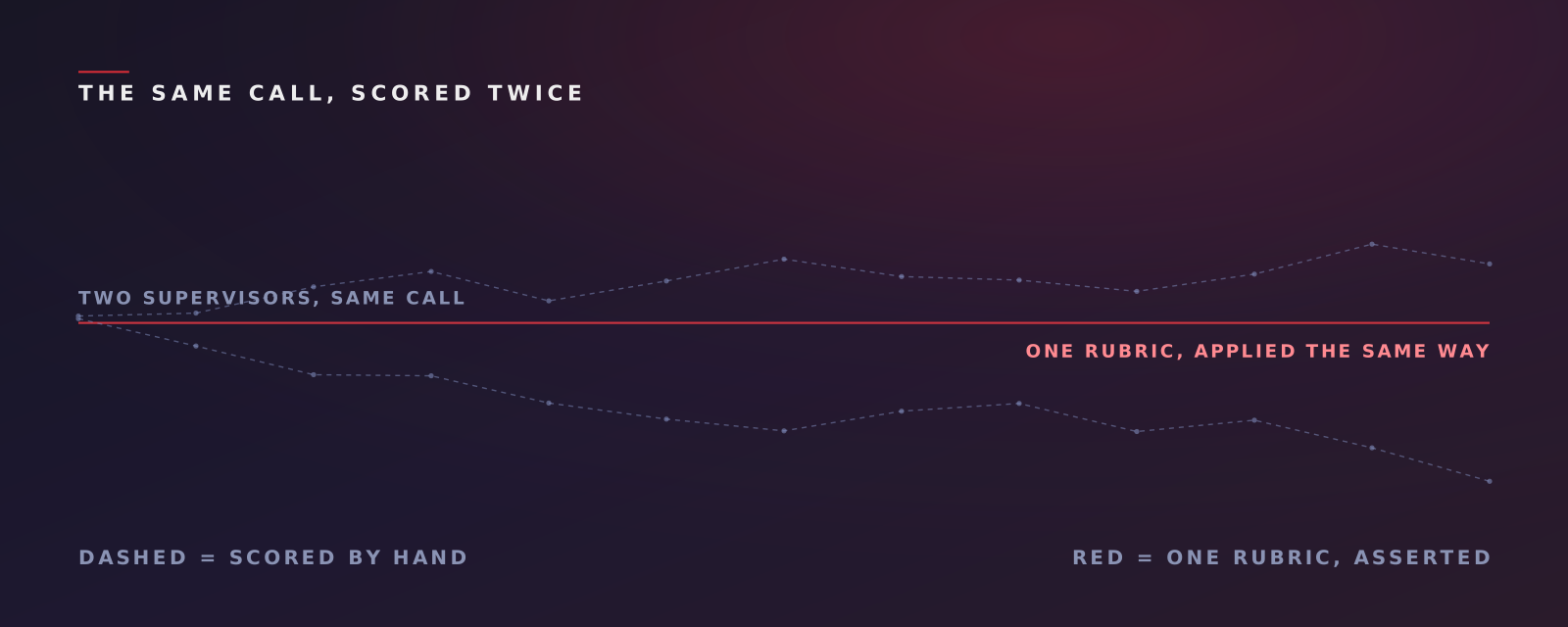
Hand the same recording to two supervisors with the same rubric and you get two different scores. Hand it to the same supervisor twice, a month apart, and you often still do. This case study is about what it takes to make agent scores comparable between people, between teams, and across time.
- 40/40/20
- opening / handling / closing, by default
- Locked
- bucket sizes, enforced by assertion
- 600+
- behaviour tags under the rubric
- Never
- how often the two scoring systems blend
Key findings
- Inter-rater inconsistency is never measured, because nobody wants to discover their rubric is a matter of opinion.
- Scores that are not comparable between supervisors, teams or weeks cannot support the two things scores exist for: ranking and trend.
- The mechanical half of scoring is locked and asserted; only the stage weights are configurable, and they must sum to 100.
- Skill presence is binary after alias-collapse — saying your name five times scores the same as once. It measures compliance with a rubric, not enthusiasm.
The experiment nobody runs
Take one recording. Give it to two supervisors with the same rubric, in separate rooms. Compare the scores.
Most QA leads have a rough idea of what would happen and a good reason not to find out. The scores diverge — sometimes by a band, often on the specific skills that matter most, and almost always on anything involving tone, empathy or escalation handling.
Run the harder version: give the same call to the same supervisor twice, a month apart, without telling them. The scores still diverge.
This is not incompetence, and it is not a training problem you can fix with a calibration session. It is what happens when a rubric written in natural language is applied by a tired human at the end of a shift, sixty calls into a week, under pressure to finish.
The rubric was never the thing being applied. The supervisor’s reading of the rubric, this afternoon, was.
Why it stays invisible
Two reasons, and both are structural.
Nobody wants to measure it. An inter-rater agreement study on your own QA programme has exactly one possible outcome that is comfortable, and it is not the likely one. So the inconsistency is never quantified, which means it is never managed, which means it compounds quietly for years.
A rubric strict enough to be reproducible is usually too crude to be useful. This is the genuine tension. You can write a rubric so mechanical that two people always agree — and it will score “did the agent say the words” rather than “did the agent do the job”. Most vendors resolve this by writing a rich rubric and hoping, which produces exactly the divergence above.
The consequence is that agent scores are not comparable between supervisors, between teams, or across time. Which quietly destroys the only two things scores exist for: ranking people fairly, and seeing whether anything is improving.
What we changed: split the rubric, do not soften it
The resolution is not a better rubric. It is separating the part that must be reproducible from the part that requires judgement, and refusing to blend them.
The mechanical half
Every call is scored across three stages, and each stage holds a fixed number of skills:
| Call stage | Skills in the bucket | Default weight |
|---|---|---|
| Opening | 3 | 40% |
| Handling | 6 | 40% |
| Closing | 1 | 20% |
A stage score is the share of that stage’s skills the agent hit — nothing else feeds it. The call score is those three stage scores combined in the weights above. That is the entire calculation, and it is the same calculation on every call, in every week, on every floor.
Four properties make this reproducible rather than merely arithmetic:
- The bucket sizes are locked and enforced by assertion, not by convention. The code asserts that the opening bucket holds exactly three skills and that the weights sum to 100. If a configuration change breaks either, the run fails rather than silently producing scores on a different scale than last week.
- Only the weights are configurable per workspace, defaulting to 40/40/20. A collections floor can decide that handling matters more than opening. It cannot decide that opening has four skills this month.
- Skill presence is binary after alias-collapse. Saying “my name is…” five times scores identically to saying it once. This is deliberate: the rubric measures compliance with a script, not enthusiasm for it, and rewarding repetition would teach agents to repeat.
- The rubric is fetched per workspace and never hardcoded — with the configuration source recorded on the run, so a score can always be traced to the rubric that produced it.
The judgemental half
Five perspectives, each graded fine / small / serious, applied by the analyst: customer satisfaction, rule adherence, escalation handling, problem resolution, agent tone.
These require understanding a conversation. No rule set produces them, and pretending otherwise is how you get the crude-but-reproducible rubric that nobody trusts.
And they never blend
The two halves appear side by side in the report and are never merged into a single number.
This is the decision that makes the rest work. A blended score tells you an agent is at 62% and tells you nothing about what to do. Two numbers side by side tell you whether you are looking at a script problem — the agent is not following the process — or a conduct problem — the agent is following it badly. Those have completely different remedies, and merging them destroys the distinction permanently.
The depth underneath
The taxonomy beneath the rubric is not a flat keyword list, and the difference matters for consistency.
600+ behaviour tags roll up into skills, and a skill can require multiple tag groups simultaneously. Acknowledging an objection, for example, fires only when the call contains both an objection and an acknowledgement of it.
That is the difference between asking “did the agent acknowledge an objection that actually happened” and “did the agent say a reassuring phrase at some point”. Most keyword-scoring products ask the second question and report it as the first — which is another source of divergence, because the same phrase means different things depending on what preceded it.
What we do not claim
We do not publish an exact tag count. You will see “600+” here rather than a precise figure, and that is deliberate: the live taxonomy is the source of truth, and a number quoted from an export is a number that can drift from it. We would rather be checkably conservative than precisely wrong.
We do not claim the rubric is the right rubric for your floor. It is a consistent one. Whether opening should be worth 40% on a collections campaign is your decision, and it is configurable for exactly that reason.
We do not claim machine scoring removes judgement. It relocates it. The judgement is still there, in the analyst’s five perspectives — the claim is that it is now sitting next to the mechanical score instead of dissolved into it.
Where to start
Run the experiment. Take one call, give it to two supervisors, compare.
Whatever gap you find is the noise floor under every agent ranking you currently produce — and it is the number worth carrying into any conversation about QA tooling, including one with us.
Book a demo and we will walk you through how the two halves of the score are kept apart, and what each one is for.
Related: What We Refuse to Score on the fairness gates that sit alongside this, and A Score Is Not an Instruction on what has to happen after a consistent score exists.
Curious what is in the 95% you never hear?
Book a demo and we will walk you through the platform — how the reviews work, what the reports contain, and how the evidence trail is built.
Book a Demo