
Case Study 08Coaching · Agent development
A Score Is Not an Instruction: The Coaching Gap in Every QA Programme
A QA score tells an agent they failed. It does not tell them which moment of which call went wrong. This case study is about narrowing the unit of feedback from the call to the line, and why the last page of a report matters more than the dashboard above it.
- The line
- the unit a flag lands on, not the call
- Agents
- the only party a coaching note attaches to
- Mandatory
- a note on every negative agent line
- By person
- how the weekly report ends
Key findings
- A score tells an agent they failed. It does not tell them which thirty seconds of which call it is talking about — and that gap is where coaching quietly stops happening.
- Generic advice — show more empathy — is what a rule engine can produce from a category match, and it is worth nothing on a Monday morning.
- A coaching note is mandatory on any negative or brand-risky agent line, and customers are never coached. Both are enforced mechanically, not by convention.
- The obvious way to satisfy a coaching requirement is to stop calling lines negative. An anti-gaming rule closes that door explicitly.
The gap between a number and a behaviour
A QA score tells an agent they failed. It does not tell them where.
Empathy: 2/5. Opening score 67%. Rule adherence: small concern. Every one of those is a verdict, and none of them is an instruction. The agent reads it, agrees or disagrees, and goes back to the floor doing exactly what they did before — because nothing in the score points at a moment they can actually remember.
The translation from score to behaviour is done by a team leader, in a one-to-one, from memory, at the end of a shift. Which means it happens late, inconsistently, and only for the agents whose scores were bad enough to make the list.
The agents in the middle — where most of the recoverable performance actually sits — get nothing at all. Not because anyone decided they should not be coached, but because there are eleven of them and one team leader with forty minutes.
The score was never the deliverable. The changed behaviour on the next call was.
Why rule engines cannot close it
A rule engine knows that a phrase matched a pattern. It does not know what the agent was trying to do, what the customer had just said, or which part of the exchange actually went wrong.
So what it can produce is the category of advice that matched — show more empathy, follow the closing script — and that advice is worth nothing, because the agent already knows they were supposed to show empathy. The team leader is left doing the real work anyway: finding the call, finding the moment, and deciding what to say about it.
The gap is not the verdict. It is the search. By the time a supervisor has located the moment a score is referring to, the shift is over.
What we changed: narrow the unit from the call to the line
The unit of feedback is the line, not the call and not the week.
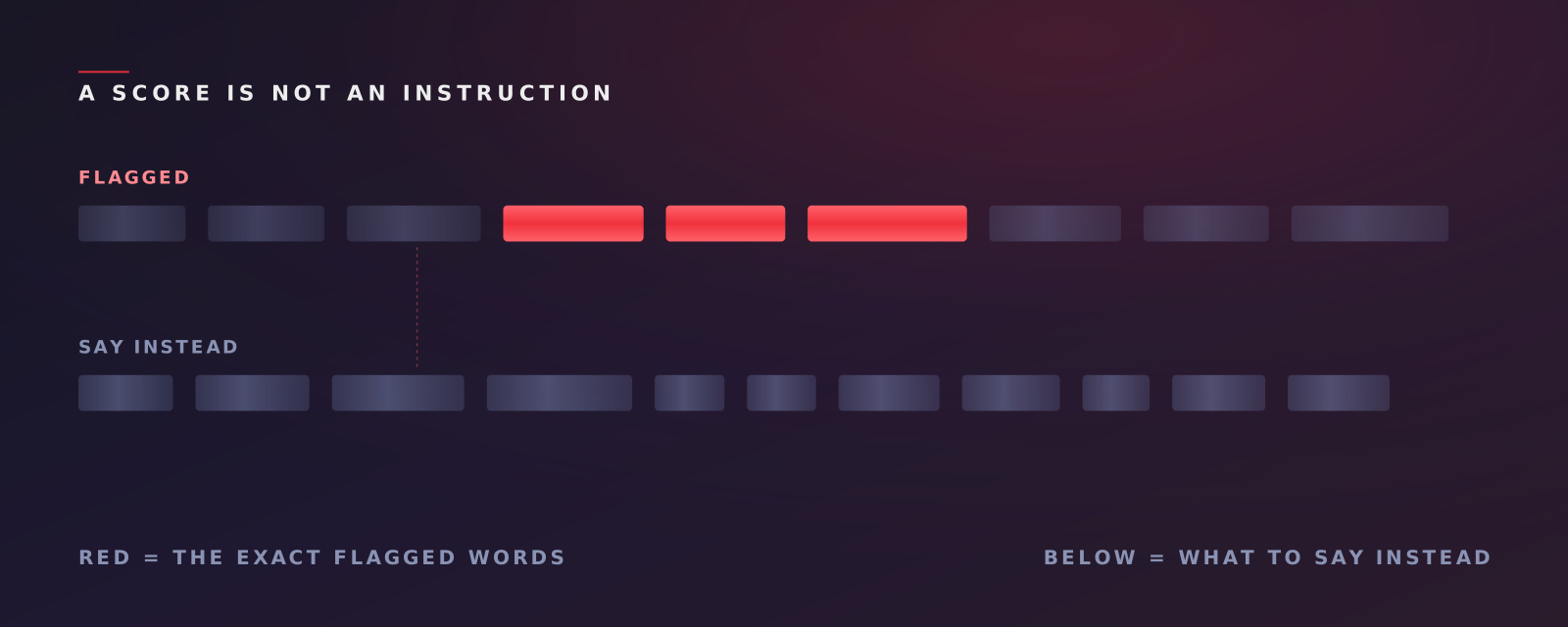
When a segment of agent speech is negative or brand-risky, the flag is attached to the exact words inside it — not to the recording, and not to a scorecard row. A supervisor opening that call does not have to go hunting for what the number was referring to.
Where it surfaces
In the application, flagged spans are highlighted inline in the transcript, with the reason for the flag alongside them. On the waveform, flagged agent moments are marked, so a supervisor can jump straight to the seconds in question and hear them in context rather than reconstructing the call from a score.
And the weekly report closes the loop at floor level: the last page is “What To Do This Week, By Person” — owner, behaviour, due date. Not a list of scores to interpret. A list of work.
Four decisions that keep it honest
1. A coaching note is mandatory, not optional. Any negative or brand-risky agent segment must carry one naming the behaviour at issue. There is no configuration that turns this into a nice-to-have that gets skipped when a batch is large.
2. Customers are never coached — only agents. Enforced mechanically. It sounds obvious until you have seen a report advising a customer on their tone, which is what happens when the step does not know who it is talking about. (This depends entirely on getting speaker attribution right — see Which Voice Is the Agent.)
3. The anti-gaming rule. The obvious way to satisfy “every negative line carries a note” is to stop calling lines negative. So the rule distinguishes:
| Case | Rule |
|---|---|
| Stance-negative — the agent is being unpleasant | Keep it negative and attach the note |
| Topic-bleed — the agent is discussing something unpleasant | Fix the sentiment to neutral, no note |
You may not downgrade a sentiment to dodge the coaching requirement.
An agent calmly explaining a repossession process is discussing something unpleasant. That is not negative conduct, and marking it as such is its own unfairness. But the distinction has to be drawn deliberately, or it becomes the escape hatch.
4. A mechanical gate enforces all of it. The batch is refused before load if a negative agent segment carries no note, if a note landed on a customer line, or if a brand-risk segment was not forced negative.
What we do not claim
We do not write the agent’s next sentence for them. The platform tells a supervisor which words on which call are the problem, and who owns fixing it. What the agent should have said instead is a judgement made by the person who knows the campaign, the customer and the agent — and we would rather hand them the moment than hand them a script.
We do not claim this removes the one-to-one. It removes the search that used to eat it. The conversation still happens between two people; what changes is that it starts from a specific line rather than from a number neither of them can place.
We do not claim a durable coaching history yet. Notes travel with the analysis and with the weekly report. A permanent per-agent coaching timeline inside the application is not something you should buy this on today, and we would rather say so here than let you discover it in month two.
Where to start
Take last month’s lowest-scoring agent and read three of their flagged calls. For each flagged line, write down what they should have said instead.
If you can do it in under a minute per line, your coaching gap is a capacity problem — you know what to say, and you have no time to find the calls. That is the half worth buying help with.
Book a demo and we will show you the flagged-line view, and the by-person page the week ends on.
Related: Two Supervisors, Two Scores on the consistent score this depends on, and The Dashboard Nobody Opens on why the coaching has to arrive as assigned work.
Curious what is in the 95% you never hear?
Book a demo and we will walk you through the platform — how the reviews work, what the reports contain, and how the evidence trail is built.
Book a Demo