From Gut Feel to Evidence: Agent-Performance Analytics That Hold Up
Ask any team leader to rank their agents and they will do it instantly. The rankings feel obvious — this one is sharp, that one struggles, the new hire is coming along. The trouble is where the ranking comes from: a few calls the leader happened to overhear, a couple of complaints, and a general impression built over months.
That impression is not worthless. But it is not evidence, and it does not survive an argument. When an agent disputes a rating, “I have a sense of your calls” is not a defensible answer. Agent-performance analytics is about replacing the sense with something that holds up.
Why gut feel quietly fails
The problem with impression-based performance management is not that team leaders are bad judges. It is that they are judging from a biased sample.
The calls a leader overhears are not random. They are the calls that happened when the leader was nearby, the ones that got escalated, the ones a customer complained about. An agent who is quietly excellent generates nothing to overhear and can be underrated for months. An agent who is charming on the calls the leader happens to catch, but sloppy on compliance the rest of the time, can be overrated just as long.
The result is a ranking that feels confident and is systematically skewed — and everyone on the floor knows it, which is why performance conversations so often turn defensive.
What “holds up” actually means
Performance analytics that survive scrutiny share three properties.
They are grounded in every call, not a sample. A score built from 100% of an agent’s calls is a fact about their work. A score built from the 5% someone reviewed is a fact about that 5%, dressed up as a fact about the agent. When every call feeds the score, “you cherry-picked my worst calls” stops being a valid objection.
They are verified, not raw machine output. An automated score that nobody checked is easy to dismiss the first time it is obviously wrong. When a trained analyst has reviewed the flags behind a score, the agent is arguing with a person’s judgement backed by the actual audio — a very different conversation.
They are specific enough to coach on. A number by itself changes nothing. “Your compliance score is 72” invites an argument. “On these three calls you skipped the recording disclosure, and here is the moment on each” invites a fix. The analytics have to carry the why, not just the what.
From leaderboard to Monday morning
The point of all this is not the leaderboard itself. It is what a team leader does with it before the Monday huddle.
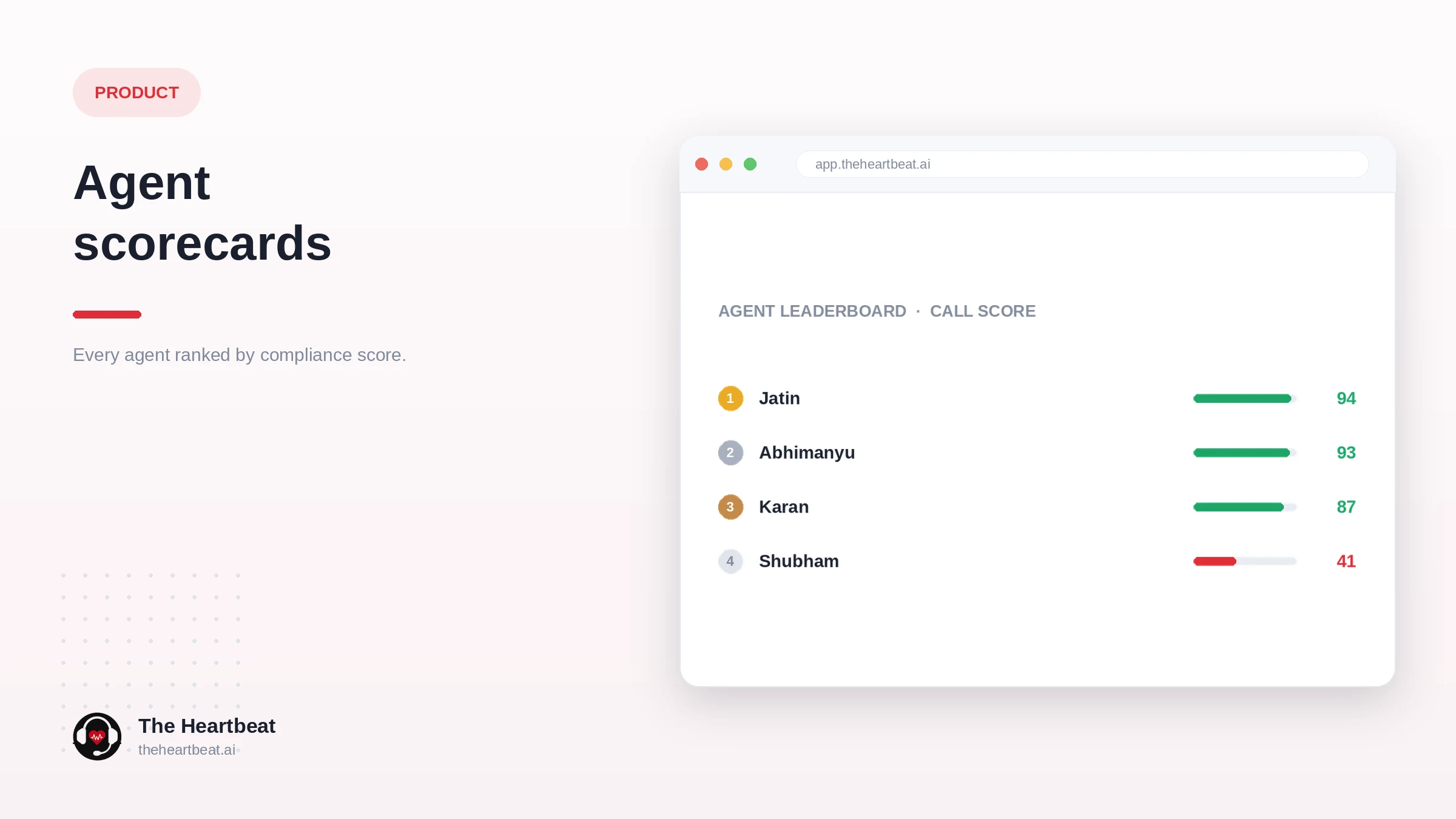
A useful performance view tells a leader, for each agent, three things: where they stand relative to the floor, which direction they are moving, and the single most coachable moment from the week — what was said, why it mattered, and what should have been said instead. That last part is what turns a ranking into a coaching plan. The leader walks into the huddle already knowing who to work with and on what, rather than picking a call at random and hoping it is representative.
Done this way, the leaderboard is not a stick. It is a way of making sure coaching time lands where it will do the most good — and of making sure the quietly excellent agent finally gets seen.
The honest caveat
Analytics do not replace judgement; they inform it. A score is a starting point for a conversation, not a verdict handed down by software. An agent having a hard month for reasons that have nothing to do with skill still shows up as a dip, and a good leader reads that in context. The value of grounding performance in every call, verified by a human, is not that it makes the leader redundant. It is that it gives the leader something solid to stand on when the conversation gets difficult — and it usually does.