When Agents Talk More Than They Listen
The customer starts explaining. “I’m calling about the order I placed last week, the delivery date keeps—”
And the agent is already answering. “Yes ma’am, delivery is 5 to 7 working days, it will reach you soon.”
Except the order was delivered. It was the wrong item. The customer wanted to return it. Now they have to interrupt the agent, start again, and explain what they were trying to say the first time.
It happens on calls in every department, and it happens most with experienced agents. They’ve heard so many calls that they’re sure they know what the customer is about to say. Often, they’re wrong.
Why talking over customers feels like good work
An agent who jumps in quickly sounds confident and knowledgeable. They keep the call moving. They rarely leave silences. On a short sample, they can sound like one of the best agents on the floor.
But talking over a customer has a cost that doesn’t show up straight away:
- The wrong problem gets solved. The agent answers the question they expected, not the one the customer had.
- The call gets longer, not shorter. The customer has to correct the agent, repeat themselves and start again.
- The customer feels unheard. Even if the problem is eventually fixed, the customer remembers being interrupted.
- Important details get lost. The one piece of information that mattered — a date, an amount, a name — was in the half-sentence the agent spoke over.
Why it’s hard to catch
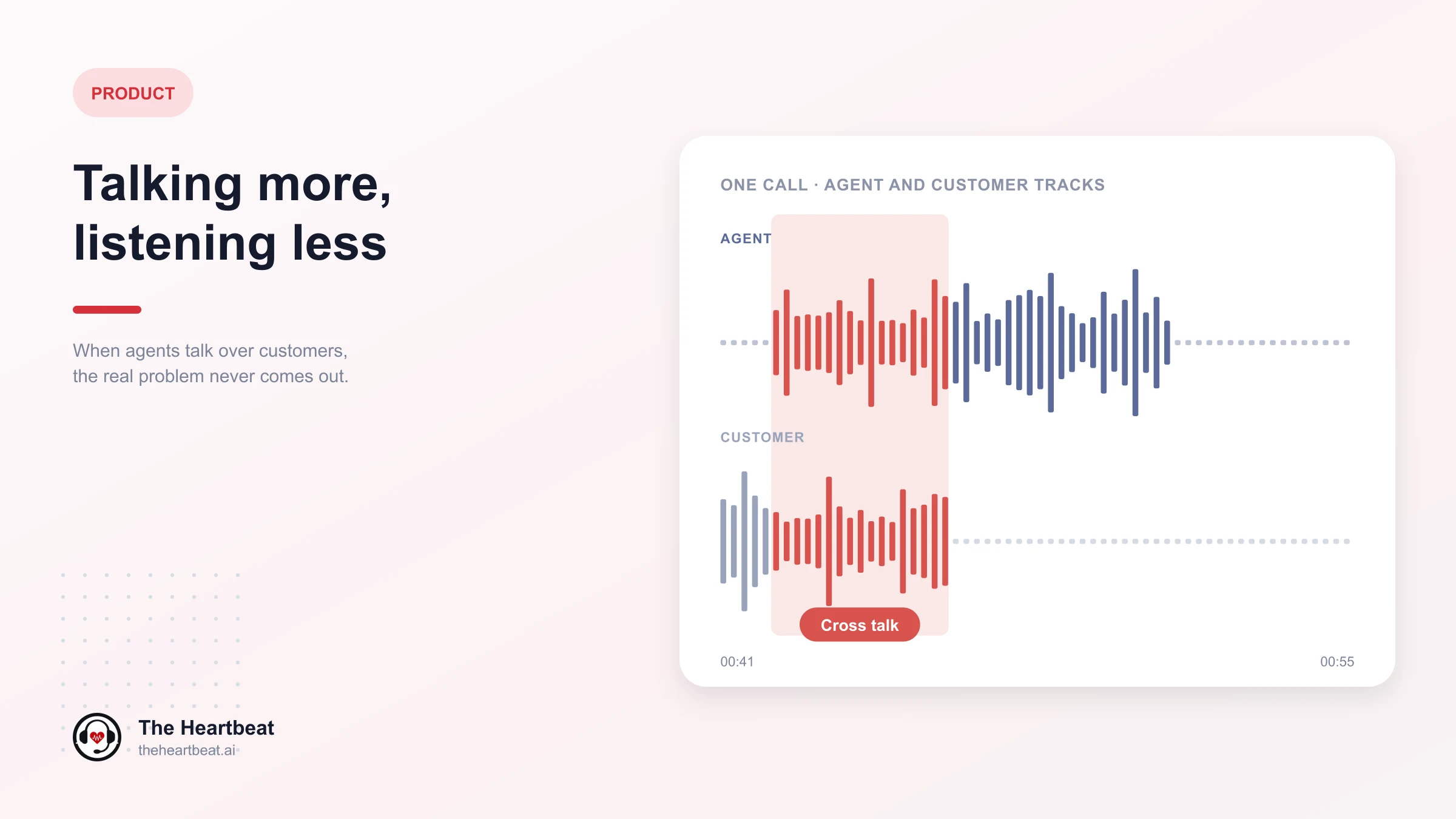
Talking over customers is almost invisible in a transcript. Two people speaking at once becomes two neat lines of text, one after the other. Reading it, you’d never know the agent interrupted.
It also varies from call to call. On easy calls, the agent’s guess is right and nothing goes wrong. On harder calls, the same habit causes the problem. A reviewer listening to a handful of calls might hear only the easy ones.
So the habit usually only comes to light when a customer complains: “the agent didn’t let me speak.”
On a single call, this looks like a small slip. Across hundreds of calls, it’s a pattern you can measure.
Measuring how much an agent talks
Two numbers show this habit clearly when they’re measured on every call:
Talk ratio — how much of the call the agent spends speaking. A very high share usually means the agent is talking over the customer or not giving them space to explain.
Cross talk — how much of the call has both people speaking at once. High cross talk is one of the clearest signs that an agent is interrupting.

From The Heartbeat app: across 50 calls, the agent side is talking 78% of the time, flagged in red. That leaves very little room for the customer to explain.
Neither number is a judgement on its own. Some calls need the agent to explain a lot. But an agent whose talk share is consistently far above the rest of the team, on calls full of cross talk, is very likely answering before the customer has finished.
Coaching agents to listen
“Listen more” is not useful feedback. Agents need something specific to do differently:
1. Let the customer finish the first explanation. Every time. Even if the agent is sure they know what’s coming.
2. Ask one question before answering. “Just so I understand, is the problem the delivery date, or the item itself?” One question turns a guess into an answer.
3. Repeat the problem back. “So the item delivered was wrong, and you’d like to return it. Is that right?” It takes five seconds and saves a minute of confusion.
4. Coach with their own calls. Play the moment where the agent spoke over the customer, then the moment the customer had to start again. Agents rarely realise how often they do it until they hear it.

From The Heartbeat app: the headline numbers for one call. The agent talked for 86% of it, and the call’s overall sentiment came out negative.
5. Check the numbers next week. If the agent’s talk share and cross talk come down, the coaching worked.
How The Heartbeat handles this
The Heartbeat reviews 100% of your agents’ calls, in any department. Analysts + AI go through every recording, in Hindi, English or Hinglish, and every AI flag is checked by a trained analyst before it reaches you.
Cross talk is measured on every call, and the call screen shows minute by minute where both people spoke at once. Each agent’s average talk share sits beside their call score, and active listening and probing are among the ten soft skills checked on every call. Your data stays in India, hosted on AWS ap-south-1 (Mumbai).
The fastest way to solve a customer’s problem is to let them finish telling you what it is.