Silence on the Line: What Dead Air Is Telling You
“One moment please.”
Then nothing. Ten seconds. Twenty. Forty. The customer checks if the call has dropped. When the agent finally comes back, the customer is no longer calm, and the rest of the call is harder than it needed to be.
Every contact centre knows dead air is bad. Very few know where theirs comes from, how much of it there is, or which agents and which situations cause most of it. Without that, the only response is a general reminder to “avoid long holds”, which changes nothing.
Why silence is easy to miss
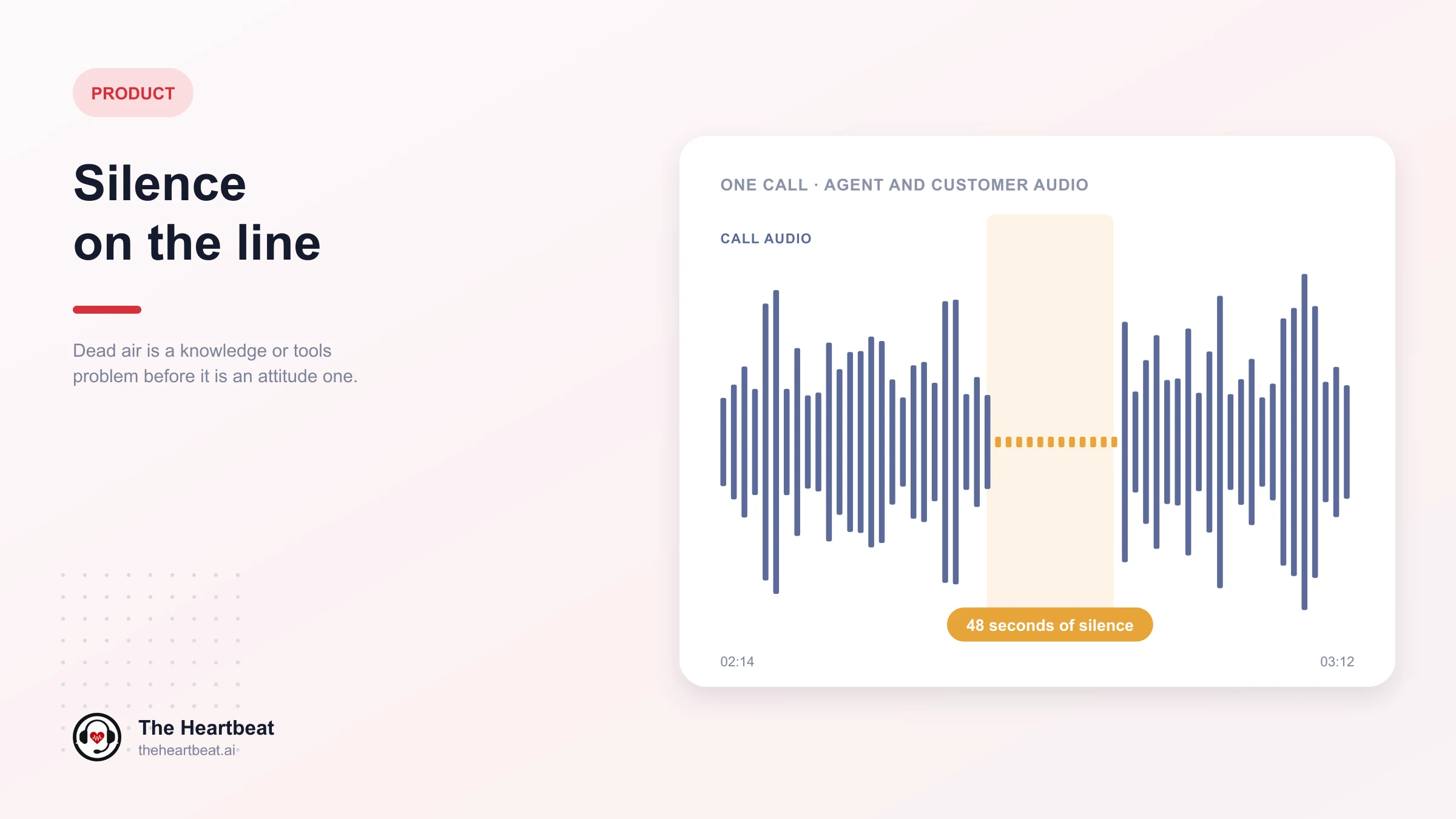
Silence doesn’t show up in a transcript. A QA reviewer reading a call log sees “Agent: Let me check that for you” followed by the agent’s next line, with no sign of the 48-second gap between them.
It’s also hard to notice when listening to a sample. A reviewer might catch one long pause and put it down to a bad moment. It takes many calls, from the same agent and the same situations, to see that the pause happens every time a customer asks about the same thing.
So silence tends to get discussed only when a customer complains about being “kept waiting”, long after the pattern has set in.
What dead air is usually telling you
It’s tempting to treat silence as an attitude problem: a careless or slow agent. Sometimes it is. But when every call is measured, most dead air turns out to have a more fixable cause:
- A knowledge gap. The customer asks something the agent hasn’t been trained on, and the agent goes looking. Silence clusters around the same few topics.
- A slow or confusing tool. The agent knows the answer, but the system takes time to load, or the information is three screens deep. Every agent on that process has the same gap.
- Searching without saying so. The agent is working, but the customer can’t tell. A short “I’m just pulling up your last payment now” would turn dead air into reassurance.
- Unclear process. The agent isn’t sure whether they’re allowed to do what the customer is asking, and stalls while deciding.
Each of these has a different fix: training, a tool change, a phrasing habit, or a clearer policy. Treating all of them as “talk faster” fixes none of them.
Reading the pattern, not the moment
The useful view is not one long silence on one call. It’s how each agent’s calls are spent, across every call they took this week.
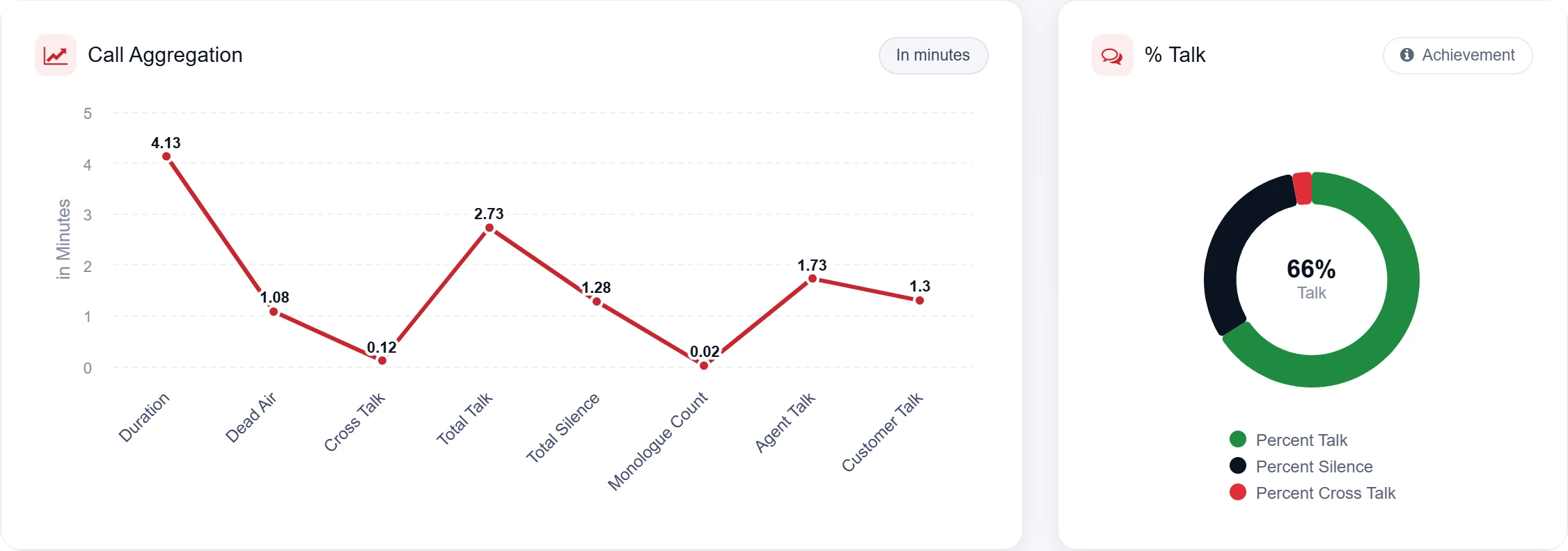
From The Heartbeat app: one 4:08 call, broken down into duration, dead air, cross talk, talk and silence. More than a minute of it is dead air, and talk covers only 66% of the call. Every call gets the same breakdown, so silence is measured, not guessed.
When silence is measured on every call, a few things become clear quickly. If one agent has far more silence than everyone else on the same process, it’s likely a knowledge or confidence gap, and coaching will help. If every agent on a process has the same long silences, the problem is the tool or the process, and no amount of coaching will fix it.
Finding exactly where it happens
Averages tell you who. The call itself tells you why. The silence usually comes straight after a question the agent couldn’t answer, or while they wait on a slow screen.
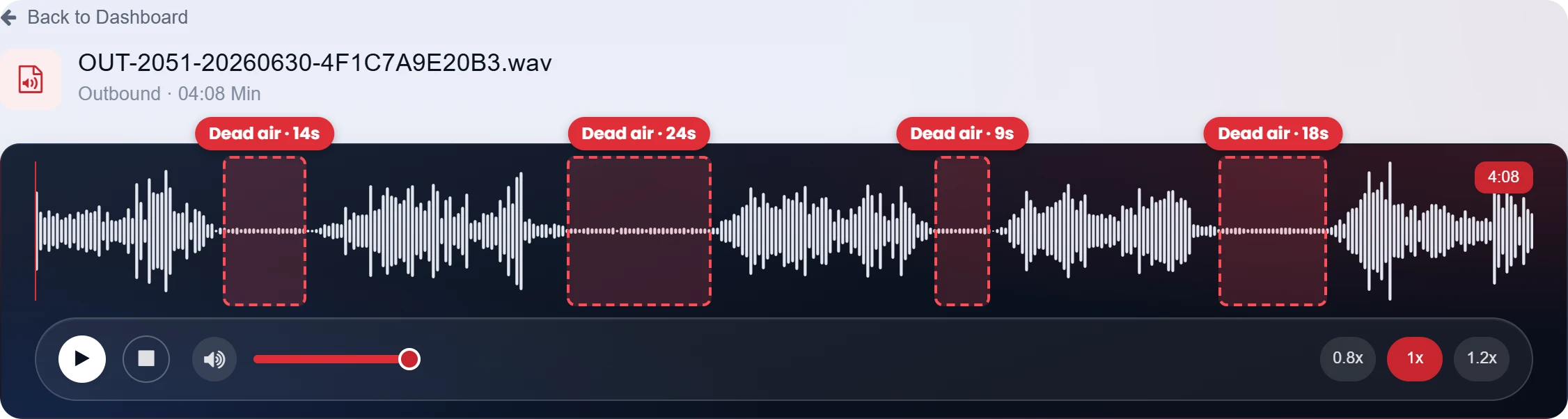
From The Heartbeat app: the same call’s waveform, with the dead air marked. Each flat stretch is a moment where nobody is speaking: 14, 24, 9 and 18 seconds. Click just before one to hear what caused it.
That is the moment to coach. Not “you had too much silence this week”, but “when a customer asks why a payment is still pending, here is where to look, and here is what to say while you’re looking.” That’s a ten-minute fix that removes the same silence from dozens of future calls.
And if the transcript shows the agent waiting on a slow screen every time, the coaching conversation belongs with whoever owns that system, not with the agent.
What to do about it
1. Measure silence on every call. Not a sample. Patterns only appear when you can compare the same agent and the same situation across many calls.
2. Separate the agent from the system. One agent with long silences is a coaching issue. A whole team with the same silences is a tools or process issue.
3. Teach agents to fill the gap. Even when a check genuinely takes time, a short update to the customer (“I can see your payment, I’m just checking why it hasn’t cleared”) keeps the call calm.
4. Treat silence as context, not a score. It’s a signal that tells you where to look. It shouldn’t punish an agent who was waiting on a system they don’t control.
How The Heartbeat handles this
The Heartbeat reviews 100% of your agents’ calls, in any department. Analysts + AI go through every recording, in Hindi, English or Hinglish, and every AI flag is checked by a trained analyst before it reaches you.
Silence and dead air are measured on every call and averaged for each agent, so you can see whose calls carry more silence than the rest of the team. On any call, the quiet stretches are visible on the waveform, so you can go straight to the moment and hear what caused it. Your data stays in India, hosted on AWS ap-south-1 (Mumbai).
Dead air is rarely about an agent who doesn’t care. It’s usually an agent who doesn’t know, or a system that’s too slow. Find out which, and the silence fixes itself.