
Dashboards Full of Numbers, but Nobody Knows What to Do on Monday
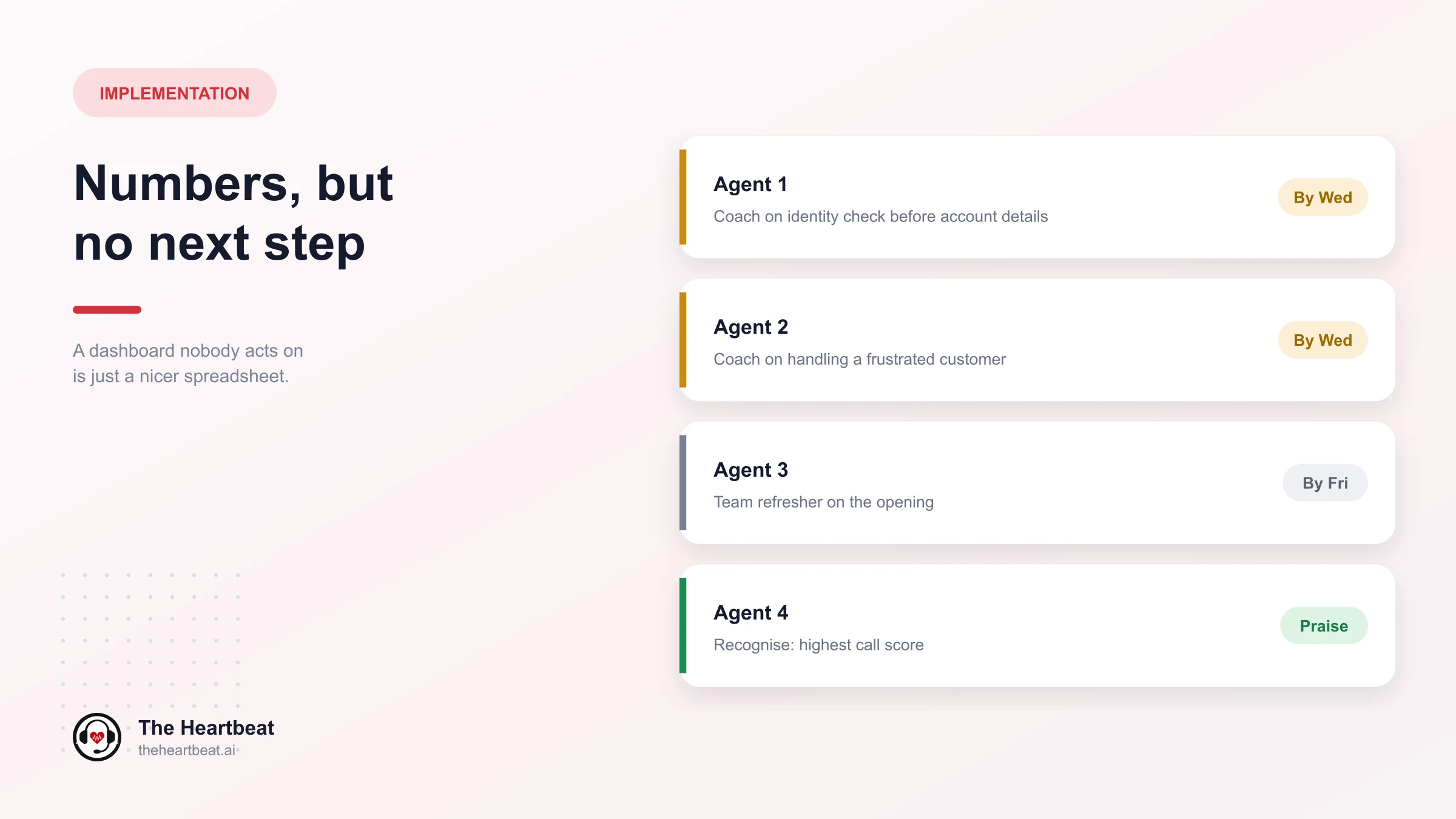
Monday morning. The weekly numbers are in. There’s a chart of call scores by team, a trend line for call length, a breakdown of sentiment and a table of agents.
The team leaders look through it. Some numbers are up, some are down. Someone says the handling score looks low. Everyone agrees. The meeting ends.
By Friday, nothing has changed. Not because anyone ignored the data, but because nobody left the room knowing what they personally had to do.
Why data doesn’t turn into action
Numbers describe; they don’t instruct. “Handling is at 64%” tells you there’s a problem. It doesn’t tell you which agent to talk to, about what, or by when.
Everyone owns it, so nobody does. When a team-wide number is low, it’s everyone’s problem — which usually means it’s nobody’s job this week.
There’s too much to look at. A dashboard with twenty charts makes every number feel equally important. Nothing stands out as the thing to do first.
There’s no deadline. Without a date, “we should coach on that” quietly becomes next month.
What managers actually need
On Monday morning, a team leader doesn’t need more data. They need a short list:
- Who to talk to this week.
- What to talk to them about, in one sentence.
- By when, so it doesn’t slide.
- Who owns it, so it’s clear who follows up.
An action list, not just a dashboard
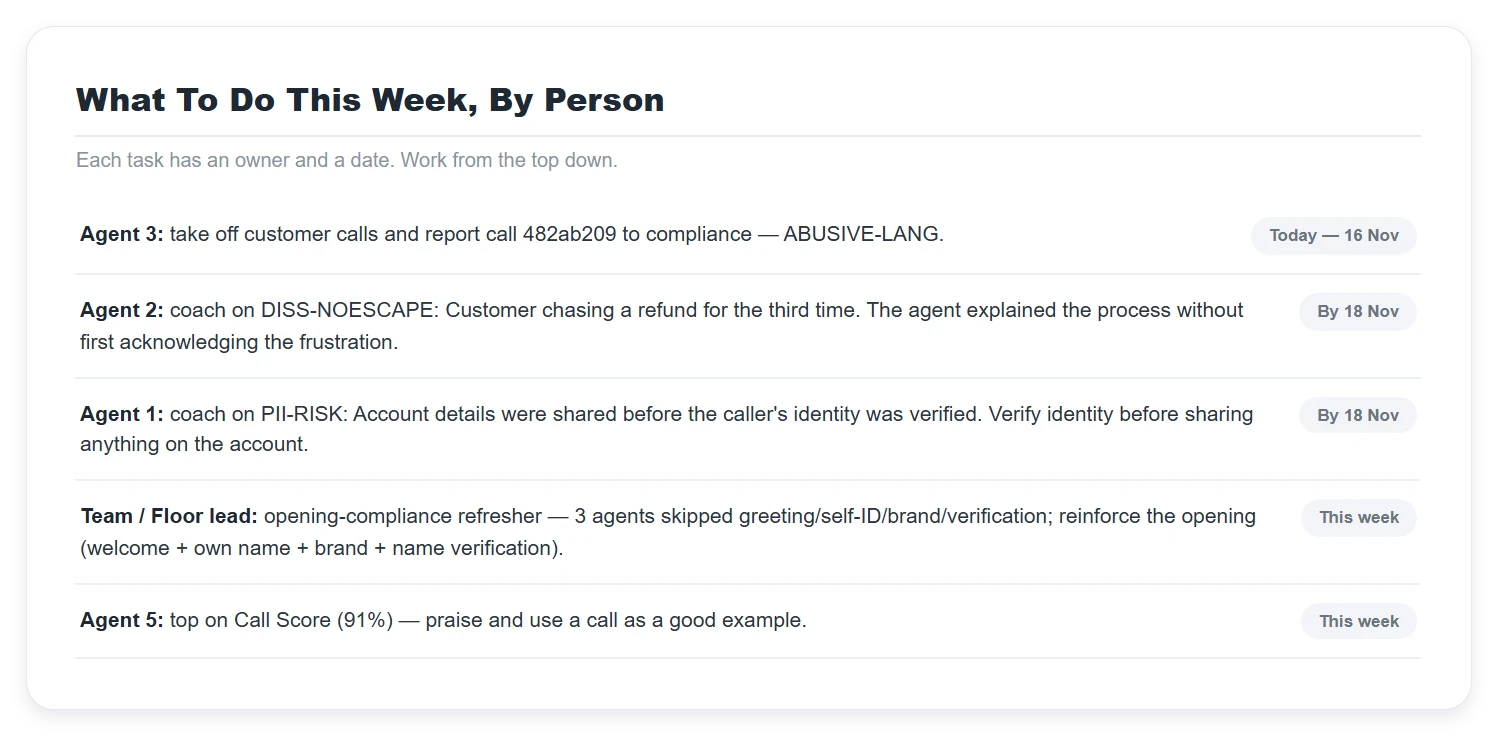
From The Heartbeat weekly report: the Monday list. Five actions, each with an owner and a date: one agent off customer calls today, two coaching items due within two days, a team refresher on the opening, and praise for the top performer. Nothing on it is a chart to interpret.
A list like this changes the Monday meeting. Instead of discussing what the numbers might mean, each team leader leaves with their own actions and a date for each one. Next Monday, the first question is simple: were they done?
Turning reports into action
1. End every report with actions. Whatever the numbers show, the last page should say what to do about them.
2. Give every action an owner. One named person. Not “the team”, not “QA”.
3. Give every action a date. Urgent issues are dated today. Coaching is dated within days, while the calls are still fresh.
4. Keep the list short. Five clear actions get done. Twenty get skimmed.
5. Include good news. Recognising a top performer is an action too, and it belongs on the same list.
6. Check last week’s list first. Before looking at new numbers, check whether the last actions happened.
How The Heartbeat handles this
The Heartbeat reviews 100% of your agents’ calls, in any department. Analysts + AI go through every recording, in Hindi, English or Hinglish, and every AI flag is checked by a trained analyst before it reaches you.
Every weekly report ends with “What to do this week, by person”: specific actions, each with a named owner and a date. Critical findings are dated today; coaching actions follow within days. When three or more agents skip the same opening step, a team-wide refresher is added, and the top performer gets a praise item, so the list isn’t only bad news. Your data stays in India, hosted on AWS ap-south-1 (Mumbai).
Data that doesn’t change what anyone does on Monday is just decoration.