
New Joiners Copy What They Hear
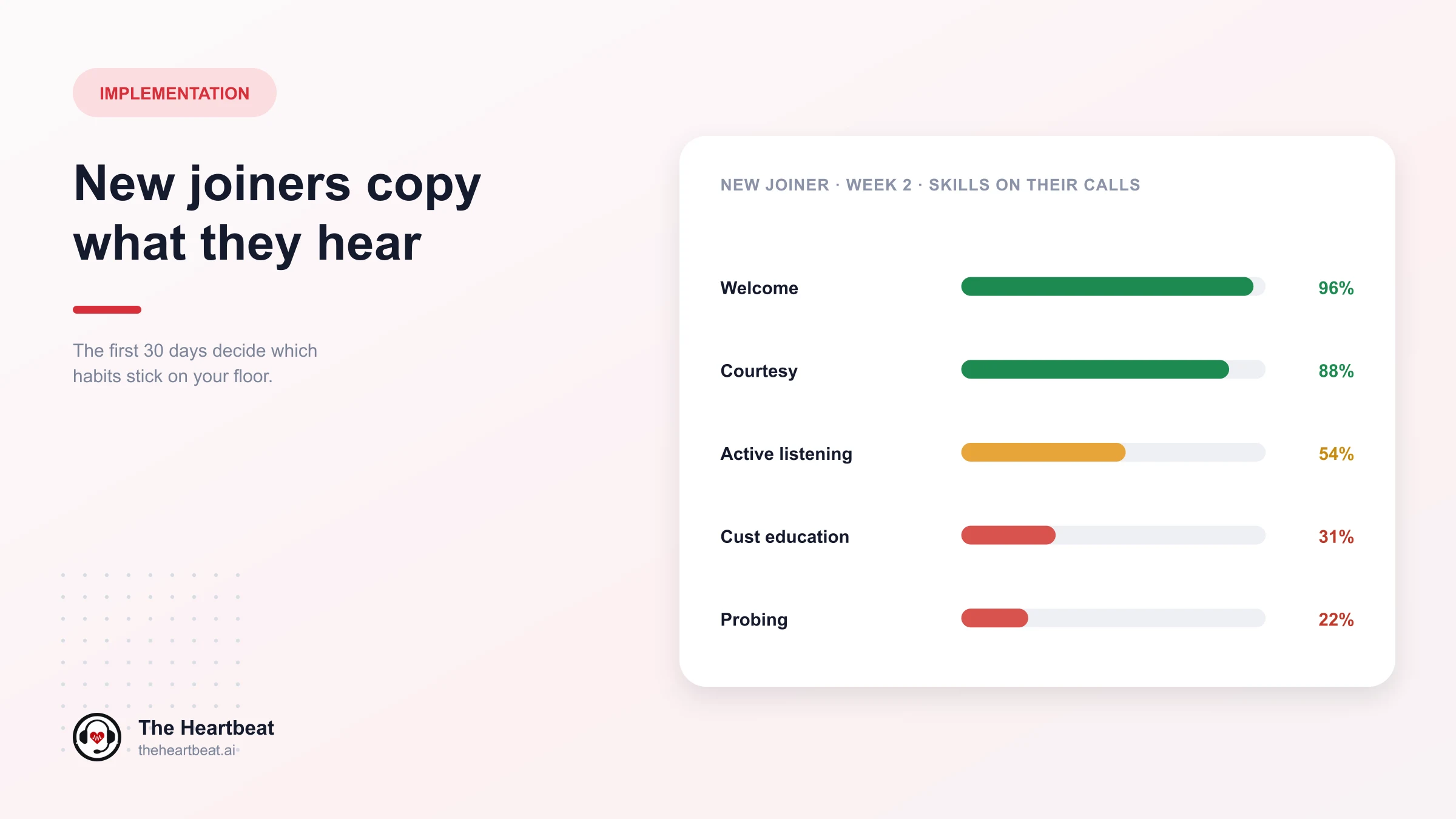
Training ends on a Friday. The new batch knows the script, the product and the process. On Monday they’re on the floor, taking real calls.
And from that moment, they stop learning from the training deck and start learning from what they hear around them. They copy the way the agent beside them opens a call. They pick up the phrases that seem to work. They notice which steps everyone else skips, and they skip them too.
By the end of the first month, those habits are simply how they handle calls. Changing them later is much harder than catching them early.
Why the first 30 days matter most
A new agent’s first weeks are the only time they are actively paying attention to how they do the job. Every call is still a little uncomfortable, so they’re looking for patterns to follow.
After that, the job becomes automatic. Agents stop thinking about how they open a call or close it; they just do it the way they’ve done it a hundred times before. Whatever habits they formed in that first month become the default.
That makes the first 30 days the cheapest moment to coach. A skipped step caught in week two is one conversation. The same step caught in month six is a habit to undo.
Why new joiners rarely get that feedback
Most new joiners get plenty of attention in training, and very little once they’re on the floor.
QA samples are small. If a team reviews a few calls per agent per month, a new joiner might have two or three calls heard in their entire first month. That’s not enough to spot a pattern.
Early feedback is general. “You’re doing fine, keep going” is encouraging, but it doesn’t tell a new agent which of their habits to keep and which to drop.
They learn from whoever is nearest. If the experienced agent beside them rushes the close or skips the name check, the new joiner learns that’s normal. Nobody tells them otherwise, because nobody heard it.
What new joiners typically miss
When every call from a new batch is reviewed, the same gaps come up again and again, across sales, support, collections and BPO processes:
- The middle of the call. New joiners usually learn the opening and the close well, because those are scripted. The middle — asking the right questions, explaining what happens next, reassuring a worried customer — is where they struggle.
- Probing. Answering the first question the customer asks, instead of finding out what the real problem is.
- Setting expectations. Ending the call without telling the customer what happens next, and when.
- Name verification. Skipped because it feels awkward, or because they’ve heard others skip it.
None of these are serious on a single call. Repeated on every call for a month, they become the way that agent works.
Seeing it skill by skill
The useful view of a new joiner isn’t one score. It’s which specific skills show up on their calls, and which don’t.
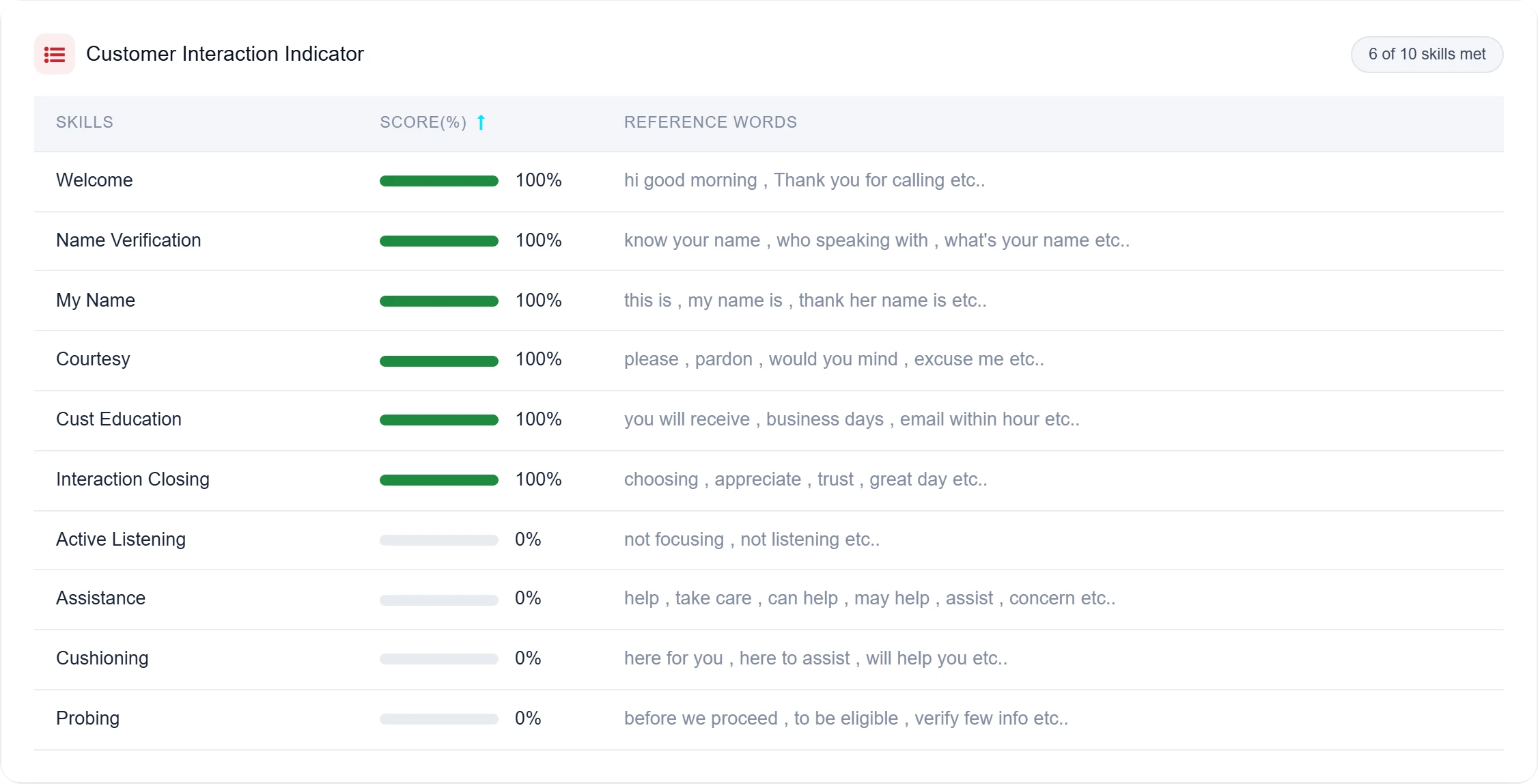
From The Heartbeat app: one call, 6 of 10 skills met. The greeting, introduction, name check and close are all there. Active listening, assistance, cushioning and probing — the middle of the call — are missing.
A view like this turns into a coaching plan on its own. The skills at 0% are what to work on next week. If they start appearing on calls in week three, the coaching is working. If they don’t, you know before the habit sets.
The same pattern shows up in an agent’s scores over a period:

From The Heartbeat app: an agent’s scores across a date range. Opening 79 and closing 82, but handling 23 — the stage where probing, listening and reassurance are scored.
What good early coaching looks like
1. Review every call in the first month, not a sample. A new joiner’s habits are forming on every call. Three reviewed calls can’t show you which ones.
2. Coach one skill at a time. A new agent can’t fix ten things at once. Pick the weakest skill, give them the words to use, and check it the following week.
3. Use their own calls. Hearing a moment from their own call, with a better line to use instead, lands far better than a general reminder in a team huddle.
4. Recognise what they’re getting right. New joiners need to know which habits to keep. Telling them their welcome and close are consistently good is as useful as telling them what to fix.
5. Watch who they’re learning from. If a whole batch picks up the same gap, check the experienced agents they sit beside. The habit may be coming from there.
How The Heartbeat handles this
The Heartbeat reviews 100% of your agents’ calls, in any department, from an agent’s very first day. Analysts + AI go through every recording, in Hindi, English or Hinglish, and every AI flag is checked by a trained analyst before it reaches you.
Every call gets a call score and a check of the same ten soft skills, from the welcome to the close. For each agent, the skills can be sorted weakest first over any date range, so you can see which one to coach this week and check the same skill again the next. Your data stays in India, hosted on AWS ap-south-1 (Mumbai).
New joiners will copy something either way. The first 30 days decide whether it’s the right thing.