Case Study 16Operating model · Service delivery
Software That Needs a Team You Do Not Have: The Delivery-Model Gap
Conversation-intelligence platforms are sold as software and consumed as a project. The customer is expected to supply the missing half — someone to configure, tune, triage and translate. Most contact centres have nobody for that, so the software works and the programme does not.
- 2
- obligations on the customer
- Overnight
- processing, every night
- Analysts
- who verify before anything ships
- Mon 11am
- IST, prioritised, as a PDF
Key findings
- Conversation-intelligence platforms are sold as software and consumed as a project. The customer supplies the missing half, or the programme does not run.
- Most contact centres have nobody to configure rubrics, triage alerts and translate output into coaching — so the software works and the programme fails.
- Sold as a service with software underneath, the customer's obligations reduce to two: connect storage once, and read a document.
- This converts the product's biggest weakness — the heaviest analysis is not fully automatic — into its clearest differentiator, because a competitor's automated pipeline ships unverified flags.
The half of the product nobody quotes for
Conversation-intelligence platforms are sold as software and consumed as a project.
Read any implementation plan in this category and count the roles it assumes the customer will supply. Someone to configure the rubric for each campaign. Someone to tune the flags down from the initial noise. Someone to triage what survives. Someone to build the recurring reports. And someone to translate the output into coaching that a team leader can actually deliver.
That is most of a full-time job, and on a busy floor it is closer to two. Most contact centres have nobody for it — not because they underestimated, but because the headcount was never in the business case. The business case compared a licence fee against auditor salaries.
So the software works exactly as specified, and the programme does not run.
The implementation succeeded. Six months later nobody could say what had changed on the floor, because the part that changes the floor was never staffed.
Why the licence model produces this
Software margins depend on the customer doing the operational half. That is not cynicism, it is arithmetic: a vendor who staffs analysis for every account has a cost line that scales with customers, which is a service business’s shape rather than a software business’s.
So the category prices as software, ships the artefact it can build cheaply, and leaves the last mile to the buyer. The last mile is where the value was.
What we changed: sell the service, put the software underneath
It is a service with software underneath, and the operating model says so plainly.
Reports are produced and delivered by our team as part of your plan — there is no button in the application that generates one.
Access to your data is restricted to the analyst team assigned to your account.
Both of those are constraints, and we publish them as constraints. The first one in particular is the sort of thing a competitor would call a limitation in a bake-off, and they would be describing it accurately.
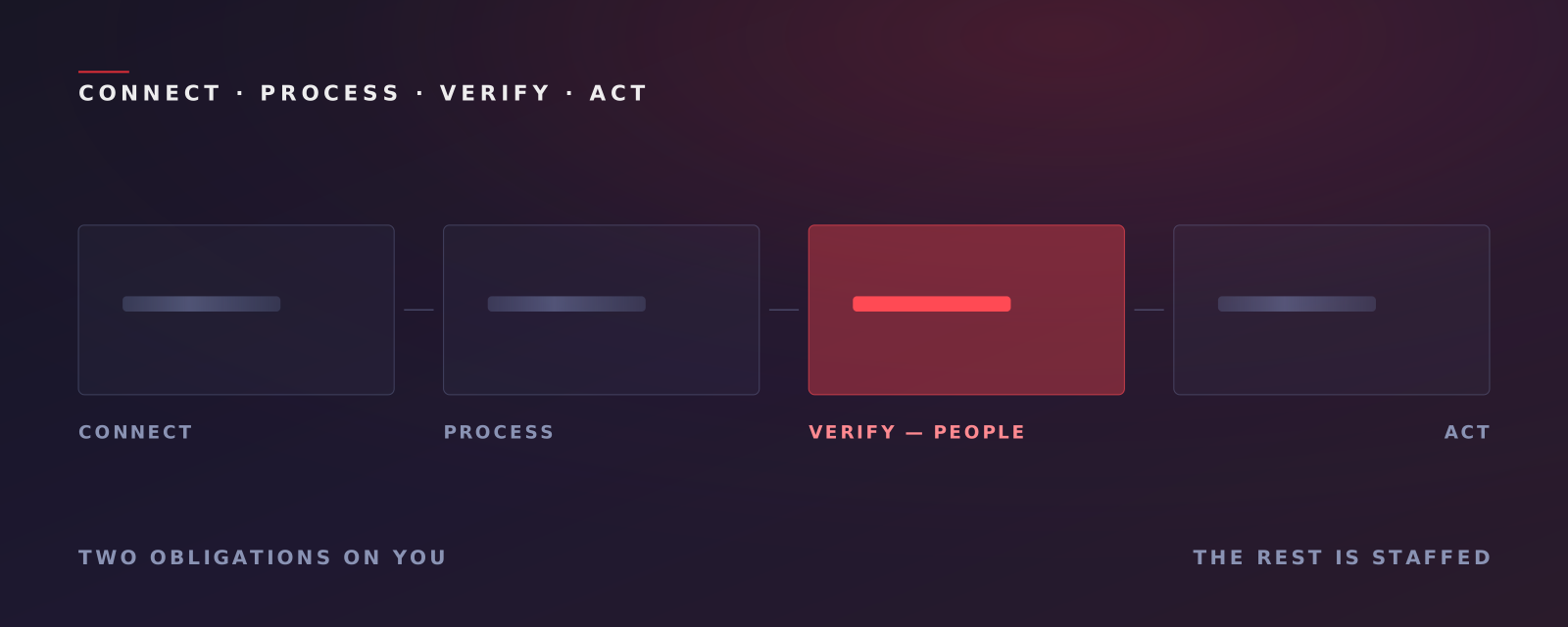
The four stages
Connect — about twenty minutes, once. Point us at the storage the dialler already writes to. (Twenty Minutes, Not Two Quarters.)
Process — overnight, every night. Every call, not a sample. (The 5% Illusion.)
Verify — analysts, before anything ships. Every flag, in the language the call was spoken in. (Four Hundred Flags.)
Act — Monday 11am IST, a prioritised document that ends in assigned work. (The Dashboard Nobody Opens.)
The customer’s obligations are two: connect storage once, and read a document. Everything between those is ours.
That is the whole argument. Not that the analysis is better — that the operational half is included rather than assumed.
Why this is the right call for this product specifically
Here is the part worth being direct about.
The heaviest analysis stages in our pipeline are not yet fully automatic. Sentiment, tagging, skills, risk classification, summarisation and masking run as a job that a person triggers, rather than as an untouched step inside the GPU pipeline. Automating that end to end is the single largest open item on our engineering roadmap.
Framed as a software company, that is a gap. Framed accurately, it is the reason the output is worth reading: a competitor’s fully-automated pipeline ships unverified flags, and ours ships verified ones. The human in the loop is not a stopgap that survived into production — it is the mechanism that makes the precision claim true, and it is priced in.
We would rather be the product that says a person checked this than the product that says nobody needed to.
What we would do differently, and the tension we have not resolved
The service model has a real cost, and it is not the one people expect.
Quality scales with analyst headcount. Analyst capacity — not compute, not storage, not model quality — is the actual constraint on how fast we can grow. Every new floor is a hiring and training decision as much as a provisioning one.
That is a business-model fact rather than a flaw, and we are not going to pretend it is a strength. It means we grow more slowly than a pure-software competitor. It means onboarding has a queue. And it means the automation work above is not optional for us — it is what turns analyst time from a ceiling into leverage.
If you are evaluating us against a self-serve platform, this is the trade you are making: slower to start, and somebody has already read the flags when it arrives.
What we do not claim
We do not claim you need no QA capability at all. Somebody on your side has to receive the report and act on it. What is removed is the configuration, tuning, triage and report-building — not the management.
We do not claim the service scales indefinitely at this shape. See above. We are automating toward a version where the analyst reviews more calls per hour, not a version where the analyst disappears.
We do not claim there is no software. There is a full application, and teams that want to dig should use it. The document is the default because most weeks most people need an answer rather than a dataset.
Where to start
The question to ask about any tool in this category, including this one: after we sign, who on my team does the work this product assumes?
If the honest answer is nobody, the licence fee is not the price.
Book a demo and we will walk you through the four stages and exactly which of them we staff.
Related: Four Hundred Flags on what the verify stage does, and Nobody Could Explain the System on the documentation work that made this model describable.
Curious what is in the 95% you never hear?
Book a demo and we will walk you through the platform — how the reviews work, what the reports contain, and how the evidence trail is built.
Book a Demo